Barry O’Neill, EHS Manager at Gaelic Laboratories, explains the role of pharma manufacturers in minimising the spread of antimicrobial resistance, and offers insights into achieving compliance with the AMR Industry Alliance Manufacturing Standard.

The emergence of antimicrobial resistance (AMR) across the world is recognised as a significant global health challenge. AMR develops when colonies of microbes like bacteria change in ways that make antibiotics less effective. In recent decades, these changes have been accelerated by human activity, such as the misuse and overuse of antibiotics. In addition, it has become clear that emissions of antibiotics from manufacturing sites can contribute to new forms of AMR. This recognition led to the concept of AMR Stewardship in antibiotic manufacturing.
Pharmaceutical manufacturers have an important role in controlling AMR, as recognised by the formation of the AMR Industry Alliance nearly a decade ago. The international coalition encourages responsible antibiotic manufacturing, enacted through a Manufacturing Standard that was updated with the latest scientific evidence in 2025. It is broadly accepted that the AMR Industry Alliance Manufacturing Standard provides the benchmark for responsible antibiotic manufacturing. It places a focus on waste management and API discharge limits.
Organisations aiming to demonstrate adherence to this Standard pursue the BSI Kitemark™ for Minimized Risk of AMR. Compliance involves a combination of operational controls, environmental risk management, governance improvements, monitoring activities, procedural strengthening, and cross-functional engagement across manufacturing, engineering, quality, environmental health and safety, and laboratory operations (Figure 1).
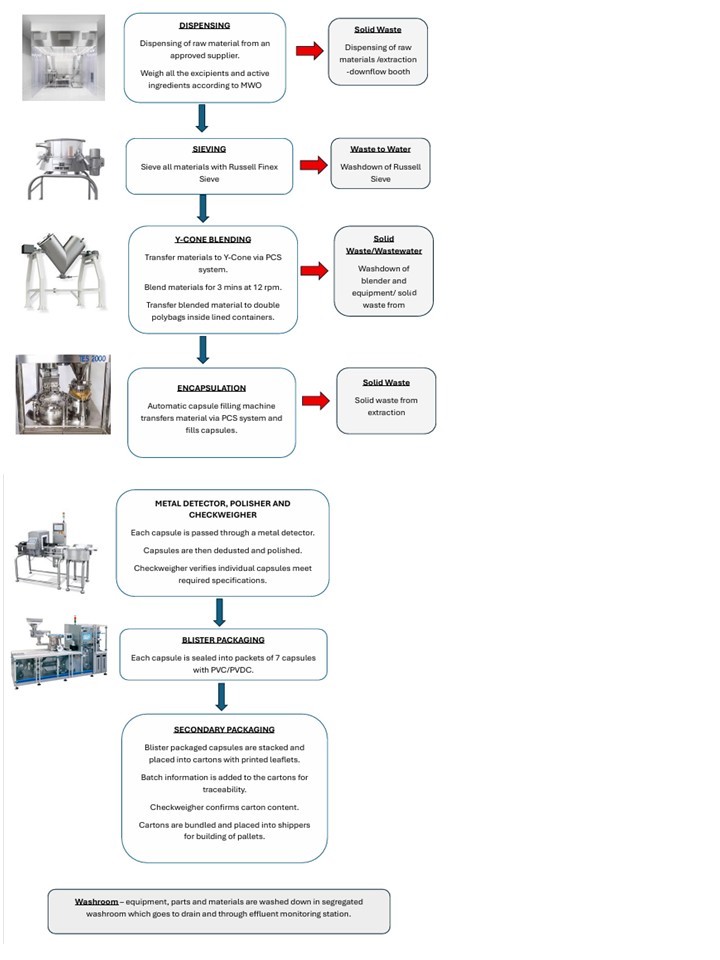
Figure 1. Schematic overview of antibiotic manufacturing, highlighting potential losses to water and waste, and the steps taken to avoid accidental release of APIs or drug products.
Wastewater Management
Concentrations of antibiotics in industrial effluents can considerably higher than those found in sewage, so AMR stewardship places a strong emphasis on wastewater management. An optimal approach is to perform routine testing by an in-house expert lab team, complemented by additional independent testing at an external local treatment platform. Such dual testing approaches ensure that any accidental leakages would be quickly detected and dealt with.
Wastewater monitoring involves the collection, analysis and management of wastewater discharged from manufacturing facilities by assessing composition, determining contaminants, and implementing measures to avoid the release of polluted water. Antibiotic residues need to be quantified to make sure they fall below the Predicted No-Effect Concentration (PNEC) for a particular antibiotic [1]. An extensive list of PNECs for available antibiotics has been scientifically calculated and is updated annually; for any new products for which a PNEC is not yet available, a default limit of 0.05 µg/L applies.
Equipment upgrades might be required at many sites for environmental controls, monitoring capability, containment practices, wastewater-related controls, and supporting systems and processes. Fortunately, before embarking on this exercise, Gaelic Laboratories had obtained a new monitoring station for effluent wastewater, as well as an upgraded extraction system that controls API air particulates. The entire site was also utility-mapped after being acquired in 2022, because the previous owners had no record of drain locations.
Solid Waste
Solid waste potentially containing active ingredients must be gathered and stored in a manner that prevents discharge. Once it leaves the site, the manufacturer remains responsible for ensuring that any chosen contractors possess relevant authorisations or certifications to manage antibiotic wastes.
For example, many antibiotic manufacturers choose to work with specialised hazardous waste treatment companies with proven expertise in pharmaceutical waste. These companies may transfer the solid waste securely to a central treatment plant, for incineration in dedicated installations. Alternatively, for antibiotic manufacturers that send their waste to landfill, the AMR Industry Alliance Manufacturing Standard includes clear guidance that it is the manufacturer’s responsibility to verify that the landfill site is designed and operated in a manner that prevents release of antibiotics into the environment.
Multiple Site Functions
Using an approach based on the AMR Industry Alliance’s Manufacturing Standard and the associated framework used by BSI, Gaelic Laboratories received the BSI Kitemark™ for Minimized Risk of AMR in May 2026 for its site in Clonmel, County Tipperary in Ireland. Work is continuing with its sister company Athlone Laboratories, situated in Ballymurray in County Roscommon.
Both companies are GMP-approved manufacturers of Beta-Lactam antibiotics, and a key focus of their integration has been the alignment of the two companies’ manufacturing processes [2]. The current goal is to ensure that both sites comply with the AMR Industry Alliance Manufacturing Standard, with streamlined upgrades across the two sites.
Conclusion
As more pharma companies commit to a more sustainable manufacturing model [3], the BSI Kitemark™ Certification for Minimized Risk of AMR aligns with wider environmental and compliance objectives. This independent endorsement for industrial responsibility, in a manner that complies with the global gold standard for preventing AMR in pharma manufacturing, provides important guarantees of responsible antibiotic development and production.
As Gaelic and Athlone Laboratories continue down this path, they join a growing number of antibiotic manufacturers that share the goals of providing critical medicines for patients, while leveraging best-practices to support a broad industry momentum to fight AMR.
gaelicathlone.com/gaelic-labs/
References
- Vestel J, Caldwell DJ, Tell J et al. Default predicted no-effect target concentrations for antibiotics in the absence of data for the protection against antibiotic resistance and environmental toxicity. Integr Environ Assess Manag2022;18:863-867.
- A strategic acquisition: insights and ideas – An interview with Brian Morrissey. Pharmaceutical Outsourcing 2026; Spring issue, pp 30–31.
- Morrissey B. Achieving sustainability in pharma manufacturing. Pharma Nature Positive 2025;4:10–12.