Lobe and Vane Pump Technologies
Throughout all areas of process engineering there are applications where the transfer of fluids requires sensitive pumping action so as not the damage or change the structure of the media being handled. Typical applications include fluids that contain solids, display either high or low levels of viscosity, have high or low temperature levels, are non-lubricating or could be made from ingredients that can be aggressive and cause damage to the pump. Such demands have not been lost on pump manufacturers and there is a considerable array of pump types that can address some, if not all, these challenges.
Rotary Lobe and External Circumferential Piston Pumps
On the face of it there’s very little difference between a rotary lobe and an external circumferential piston pump as they both essentially use the same operating principle involving interlocking lobe shaped rotors to move a fixed volume around the pump chamber. However, ECP rotors have much larger heads than their rotary lobe counterparts, with shallower curves resulting in a much longer sealing path between their outside face and the internal surface of the pump chamber.
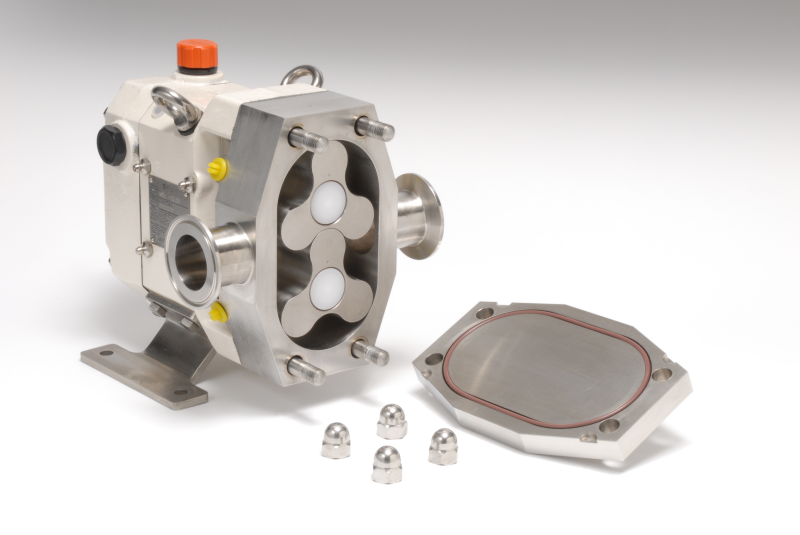 Rotary lobe pumps (Fig.1) employ timing gears which eliminate contact between the rotors and enables them to handle non-lubricating fluids. There are various designs of rotor, including bi-wing and multi-lobe options. Providing low shear and gentle handling of the liquid, thereby minimising product degradation, rotary lobe pumps are also easy to clean in place (CIP) or strip clean between operations for batching applications. They are commonly employed in food processing because they can handle more delicate solids without damaging the product. The size of the particles contained within the fluid being pumped can be much larger in lobe pumps than in other types of positive displacement pumps (PDP) because the lobes do not make contact.
The ECP pump (Fig.2), whilst offering many of the benefits of the rotary lobe pump, employs arc-shaped rotary pistons, or rotor wings, that travel in annular-shaped cylinders machined in the pump body. The resulting long sealing path reduces slippage and produces a smooth product flow without destructive pulses or pressure peaks, and without the need for valves or complex parts. Because the rotors produce a scooping action, they do not squeeze the fluid. This pump combines a very gentle, pulse-free pumping action with the high suction capacity necessary for allowing thick mixes to be drawn into the pump without any separation of the ingredients.
The longer sealing path of the ECP pump improves considerably the level of containment within the liquid cavity, reduces the pressure at the point of contact and results in a smoother flow with virtually no pulses or pressure peaks. ECP pumps can pump the most delicate of products and can cope with extremely viscous fluids that are far beyond the scope of virtually any other pump type. Having virtually no back slippage of liquid, their dosing accuracy is as high as 2-3%.
With the ECP pump there is no contact between the rotors and the pump casing, which is important when pumping dilatant slurry. When the pump is stopped any remaining fluid falls to the bottom of the cavity and begins to solidify. On restarting, the slurry is scooped up by the rotor and moved into the collapsing cavity where fluids from the two rotors meet on the discharge side of the pump. There, the slurry material is again mixed and re-suspended without stress or damage to the pump.
Vane pumps
Although rotary vane pumps can accommodate some of the applications which ECP pumps handle, they are not to be perceived as a direct alternative. Rotary vane pumps (Fig.3) employ several vanes that are free to slide into or out of slots in the pump rotor. As the rotor turns, vanes move out of the rotor slots creating a void at the inlet port and drawing fluid in. The fluid is transferred from the inlet port to the discharge port between the vanes. At the outlet, the fluid is discharged and the pumping chamber is reduced and the vanes slide back into the rotor slots.
The sliding vane pump delivers a gentle action so that the structure of the pumped fluid is not affected. Typical applications include handling clean, non-corrosive industrial liquids and petroleum products including fuel oils, lube oils, aviation fuels and a variety of solvents and thinners. When it comes to light, non-lubricating fluids such as alcohols and solvents then vane pumps are very often the best solution as they are self-lubricating and can (with the correct design) cope with low NPSH.
AxFlow Ltd
Orion Park
Northfield Avenue
London W13 9SJ
Tel: 020 8579 2111