The digital revolution used to be the future. Now it’s here. Many business sectors such as finance, media and retail have already experienced the full force of the changes but large parts of the packaging and manufacturing industry still need to adapt.
The rise of available data and connectivity, analytics, human-machine interaction and improvements in robotics characterise the fourth industrial revolution. The wave of digital change that started in the mid-2010s shows no signs of slowing, and manufacturers must embrace all that Industry 4.0 has to offer to remain competitive.
Information technology (IT) is impacting processes in a fundamental way as the lines between IT and operational technology (OT) become blurred. OT is represented by the hardware on the factory floor – the devices doing the actual work. In many cases these pieces of equipment are already automated, but frequently in a piecemeal and insular fashion, just integrating a few machines that affect a certain part of the process. With Industry 4.0, all machinery, control systems, and IT systems will be connected horizontally and vertically throughout the organisation, cooperating to achieve the most optimal outcome.
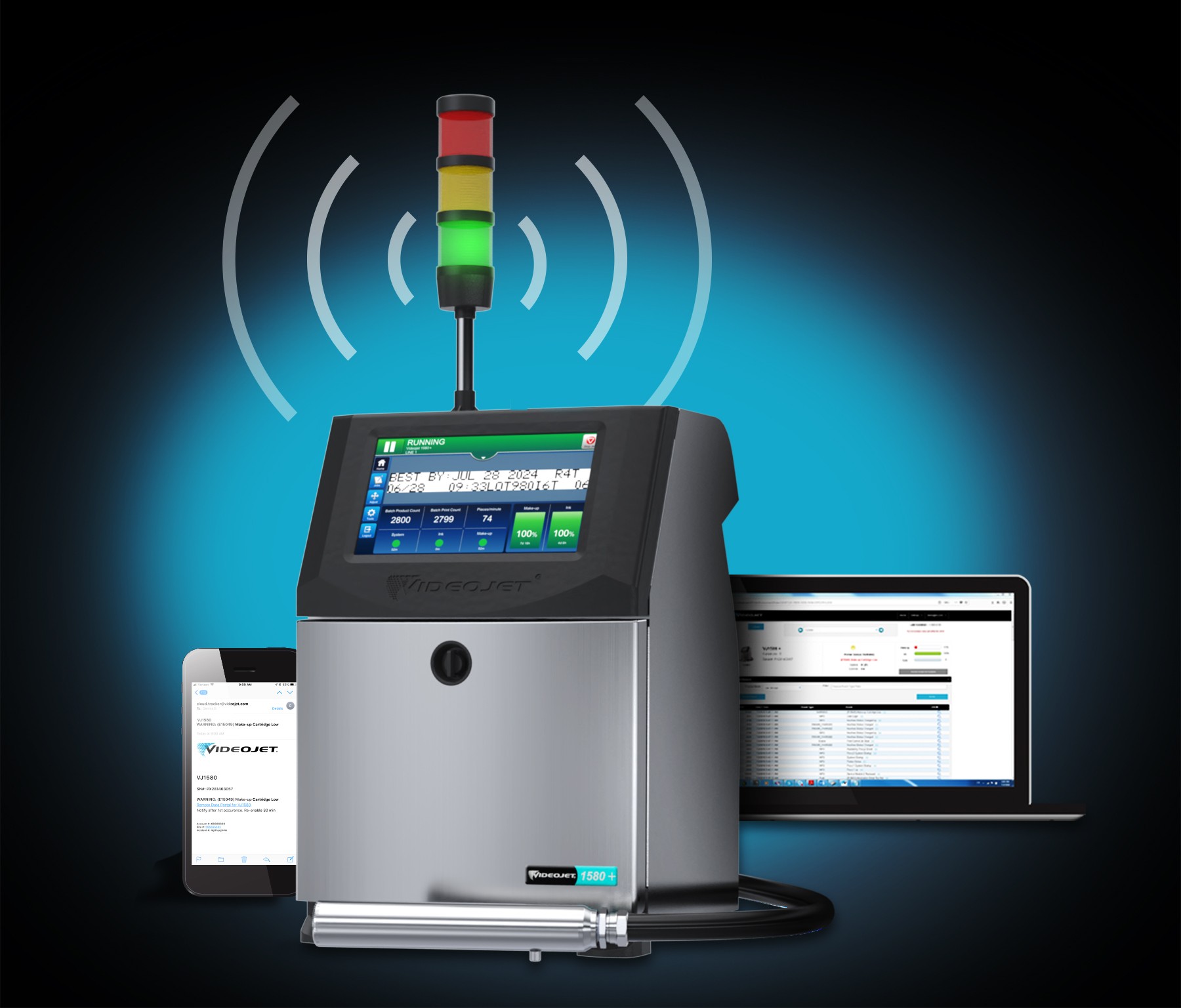
With connectivity as a key factor in driving efficiency, Videojet has put this at the heart of its latest product developments. Its new CIJ (continuous Inkjet) and Laser coding and marking machines are equipped with cellular and WiFi connections as standard to give end-users access to operational data, diagnostics and machine controls from anywhere in the world.
Scott Wilson, Regional Sales Manager at Videojet, said: “Connected production floors allow companies to monitor equipment and machinery, tracking their status at any given moment. Leveraging the data available from their machines means that manufacturers can improve performance, prevent asset failure and make decisions based on facts which could otherwise be left to guesswork.”
Factory managers can now track production speeds, error rates and equipment performance with unparalleled precision. Videojet’s 1880+ Continuous Inkjet (CIJ)] printer is the most technologically advanced printer ever built. It has 53 sensors that monitor processes in real time. The sensors inside the machine track its performance and follow the sequence of events that develop into a fault. The accompanying Videojet MAXIMiZE™ advanced diagnostics suite continuously monitors printer health parameters to help operators easily identify if a fault is likely to occur. If a failure is anticipated, a message can be sent to the manager on the production line.
With several components being monitored, troubleshooting is swift and accurate. For example, if the pump speed has slowed and is recording a higher-than-usual operating temperature, there is likely a blockage in the cooling air inflow. By reading the data from multiple sensors, the machine can self-diagnose and suggest the steps needed to fix the problem. The printer provides on-screen notifications and the on-board videos walk users through proactive maintenance routines. The goal is to reduce the main causes of unplanned printer downtime.
In a study by the McKinsey Global Institute, the maintenance costs of factory equipment are estimated to be reduced by 10-40% with predictive maintenance. Better maintenance means machinery works better and lasts longer. Improved maintenance could cut capital equipment investment in machinery by 3-5%.
Scott added: “Uptime is critical to the profitability of any business. While emergency repairs are costly, the greater damage to the bottom line is due to the unexpected time the asset is down and not contributing to production. Prolonged stoppages can have a longer-term impact on customer relations if it leads to delayed or unfulfilled orders. Preventive maintenance is far better than emergency repair in all scenarios.”
Where mechanical intervention is required, Videojet + Clearmark customers are well served with a network of 36 field engineers covering the UK and Ireland. However, machines connected to Videojet’s remote service network, VideojetConnect, can often be repaired remotely, with seven out of ten issues that don’t require parts fixed without an engineer needing to visit the site.
The latest ‘Born Digital’ range of connected coding and marking machines offer more than improved maintenance schedules. The printers produce two sets of data – process data that describes what is going on at the production line and operational data that relates to the printer’s own requirements. This solution is very robust and helps to ensure the completeness of the data. Inbuilt cellular connections also eliminate the need to use the customer’s own IT infrastructure to communicate between the Videojet cloud and the printer. Machines are typically fitted with SIM cards from three different networks to ensure they can always be accessed.
With the customer’s permission, Videojet is collecting anonymous analytics data across its population of printers to draw conclusions from varying running conditions. This information is used to improve the reliability of printer hardware, as well as to provide performance data to help prevent unplanned downtime with the use of analytics and artificial intelligence (AI).
Connectivity in coding and marking machines is not just about enhancing data gathering and decision-making; it’s a catalyst for a fundamental shift in how manufacturers interact with their production processes. As the manufacturing landscape evolves, the future promises not just faster production lines but smarter and more sustainable manufacturing processes.