 Manufacturers across the process industry encounter a number of different mixing processes for various applications and products; often multiple processes are required to create one product. Whether that is forming a stable emulsion for cosmetic creams, reducing particle size for chemical slurries or incorporating challenging gums and thickening agents in food applications, selecting the right type of mixing equipment is critical to the quality of the end product. In some cases, a mixer may be able to undertake the mixing task perfectly well, but another could achieve the same or better results in half the time. So what are some of the different types of mixing equipment available and what do they do? In this article Silverson Machines summarises some of the key differences between conventional mixers and their high shear Rotor-Stator counterparts.
Laboratory Stirrers and High Speed Dispersers vs. Rotor/Stator Mixers
Laboratory stirrers come in a wide variety of forms, but, like their production equivalents, their use is limited to duties such as maintaining uniformity in the vessel, promoting heat transfer, simple blending and dissolving tasks etc. At the other end of the scale, high speed dispersers offer high shear mixing and can be used for more complex mixing applications such as the formation of emulsions and disintegration of solids. However, the high speeds of 25,000 rpm or more at which these mixers operate cannot be replicated on a production scale, meaning products produced in the laboratory cannot be scaled-up without the need for additional R&D work.
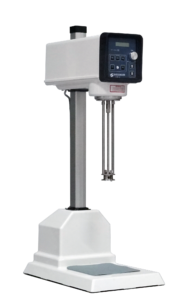
Silverson Laboratory mixers run at slower speeds, but there is a direct correlation of rotor tip speed between laboratory and production scale mixers, making scale-up a relatively easy process. All Silverson rotor/stator mixers come with a range of interchangeable workheads, giving manufacturers more versatility and allowing one mixer to be used for several mixing applications.
 Conventional Agitators vs. Batch Mixers
Agitators are one of the most common types of mixers and there are many designs available covering a wide viscosity range. These mixers are normally scalable from the laboratory to larger batch sizes. An agitator is ideal for maintaining in-tank movement and for ensuring uniformity in the tank and for promoting heat transfer in jacketed vessels. These mixers can be used for dispersing powders but powder addition must be carefully controlled as once agglomerates have formed in the mix, these low shear devices are unable to break them down. Even after a long mixing time a filtration stage may be needed to remove agglomerates remaining in the mix. Not only does this add to processing time, but also increases processing costs as full yield of expensive raw material would not be achieved.
Silverson in-tank Batch mixers can reduce mixing times by up to 90% when compared to agitators. The high speed rotation of the rotor draws the powder and liquid into the workhead where it is subjected to intense high shear in the gap between the rotor and the stator before being forced out through the holes in the stator and projected back into the mix . This quickly achieves an agglomerate-free mix and consistent results time after time.
Static Mixers and Inline Agitators vs. In-Line Mixers
Static mixers are made up of a series of baffles within a section of pipeline, designed to disrupt the flow of product. They have to be pump fed and their main application is simple liquid/liquid blending. In-Line agitators, which as the name suggests, comprise an impeller mounted within a chamber in the pipeline, are similar in their application – and as with their in-tank counterparts, the low shear nature of this type of mixer means that their application is limited to simple blending of like-viscosity fluids
For more demanding duties such as blending liquids of differing viscosities, emulsifying, dissolving or disintegrating solids, high shear is required and, where a high shear In-Line mixer is used in place of a static mixer it can replace both the static mixer and feed pump. Silverson In-Line mixers are self-pumping and incorporate the same rotor/stator workhead as in-tank models. All Silverson interchangeable workheads are machined with close clearances between the rotor and stator, resulting in low droplet sizes and significant particle size reduction making these mixers suitable for producing emulsions, dispersing powdered ingredients into liquid and disintegrating solids.
The Silverson Advantage
Traditional mixers have their place in the manufacturing process but are limited in what they can do and the results they can achieve. Silverson High Shear mixers can be advantageous to manufacturers during R&D due to the scalable results, to those looking to reduce costs and processing times as one mixer can do the job of many and for those looking to improve the quality of their end products.
If you’d like to find out more, visit the Silverson website: www.silverson.co.uk