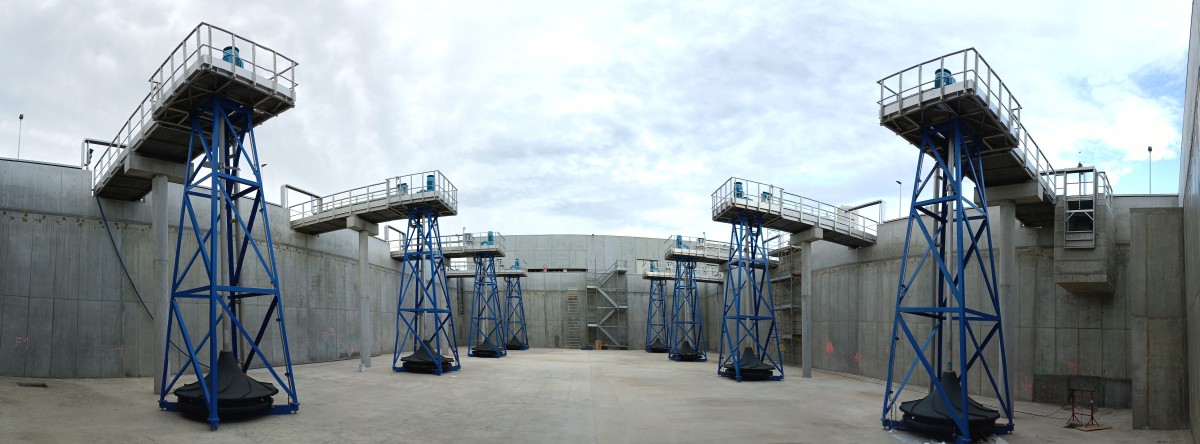
In Italy’s Chiampo Valley, industrial wastewater from the leather industry poses particular challenges for water treatment. With INVENT HYPERCLASSIC®-Mixing and Aeration Systems, plant operator Acque del Chiampo is boosting the performance of its biological treatment stage – thereby improving the efficiency of the entire plant.
With its powerful technology, the Arzignano wastewater treatment plant can cope with exceptional loads. This is because the region is one of the largest centers for leather production in Europe and one of the most important industrial areas in Italy. Around 30% of European leather is processed here, and around 1% of Italy’s economic output is generated here.A strong industrial location places special demands on wastewater treatment:
- Up to 30,000 m3 of wastewater is fed into the plant every day via an industrial wastewatersystem around 40 km long.
- Wastewater from the leather industry is particularly complex and requires the removal of high BOD and COD levels, significant nitrogen and ammonia concentrations, as well as surfactants, sulfites, chlorides, PFAS residues and chromium.
- The treatment process must reliably manage significant process-related fluctuations in wastewater volumes.
- In addition to industrial wastewater, the plant treats up to 15,000 m3 of domestic wastewater every day, corresponding to a total capacity of approximately 1.63 million population equivalents (PE).
Comprehensive modernization: 8 HYPERCLASSIC®-Mixing and Aeration Systems combine high performance with environmental protection
The wastewater treatment plant in Arzignano was designed back in 1976 to meet the enormous demands of the industrial region and has been continuously developed ever since. Now, the plant is undergoing comprehensive modernization, with Acque del Chiampo aiming to set new technological standards in environmental and health protection.
The upgrade is being carried out during ongoing operations. First, a new bypass tank was built, in which the eight HYPERCLASSIC®-Mixing and Aeration Systems are used. Four additional tanks are now being retrofitted without interrupting operations. Once this conversion is complete, 28 HYPERCLASSIC®-Mixing and Aeration Systems will ensure powerful and efficient mixing and aeration of the biological process.
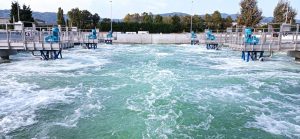
The SOTE pure water test (certified from independent bodies) confirms the excellent oxygen transfer rates, as well as the complete mixing of the basins
The HYPERCLASSIC®-Mixing and Aeration Systems – a perfect match
To meet the demanding requirements of biological treatment, Acque del Chiampo was looking for a system that could treat large volumes of highly contaminated wastewater in an energy- efficient manner, withstand the demanding wastewater properties of tanneries over a long period of time, and be robust against load fluctuations.The HYPERCLASSIC®-Mixing and Aeration System meets these requirements:
- A high oxygen input combined with stable mixing keeps even heavy tannery pollutants suspended. This prevents them from sinking to the bottom of the tank, which improvesprocess quality and keeps the tanks clean and virtually free of deposits.
- The oxygen gradients generated in different areas of the tanks enable optimized process control, which ensures a trouble-free biological degradation process even with fluctuating water volumes.
- The homogeneous oxygen distribution ensures maximum efficiency in aerobic degradation. This leads to significant energy savings throughout the entire process.
- A practical frame construction improves accessibility, making maintenance tasks easier to perform.
SOTE and MIX tests confirmed the performance of the HYPERCLASSIC®-Mixing and Aeration Systems
With 97.1% COD degradation, 99.1% solids removal, and 91.9% nitrogen reduction, the plant demonstrates above-average cleaning performance. It illustrates how the renewed biological stage – driven by INVENT’s mixing and aeration technology – increases the performance level of the entire plant and process stability.
The cooperation with Acque del Chiampo thus impressively illustrates how intelligent, resource- saving wastewater treatment can also be successful in the demanding leather industry.