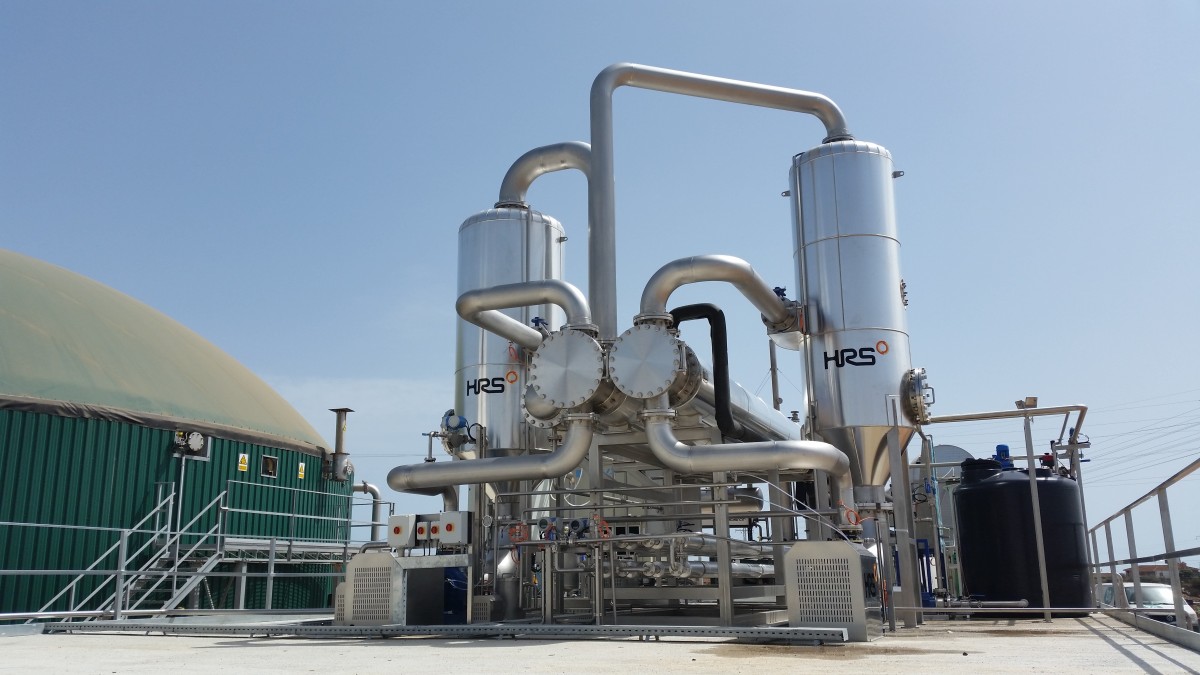
Above: The HRS Digestate Concentration System (DCS) reduces the volume of digestate from anaerobic digestion while increasing its nutritional value
By Matt Hale, Global Business Development Director, HRS Heat Exchangers

As key players in the global biogas industry prepare to descend on the NEC, Birmingham (UK) for the World Biogas Expo on 8-9 July, world events and recent research have shone a spotlight on the key role that renewable biofertilisers – such as digestate – can have in agriculture and food production, and the importance of correct handling and processing.
America’s war with Iran and the closure of the Strait of Hormuz illustrate just how reliant global agriculture is on a concentrated and limited supply of synthetic fertiliser. However, a recent report from the European Biogas Association (EBA) reveals that ‘the environmental and nutrient value of digestate exceeds €1 billion per year’, and that, ‘by 2050, Europe’s biogas sector could generate around 177 million tonnes of fertilisers from nutrient-rich waste streams’.1
Even at current rates of anaerobic digestion across Europe, the estimated 25 million tonnes of digestate dry matter produced in 2024 could ‘technically replace more than 16% of mineral nitrogen fertilisers used in European agriculture, alongside up to 30% of phosphorus and 10% of potassium demand.’
As the EBA’s Senior Policy Advisor Lucile Sever explained, “Digestate is becoming a strategic resource for Europe’s fertiliser resilience and circular economy objectives. Creating stable market conditions and a coherent EU framework for bio-based fertilisers is essential to unlock investment and scale up nutrient recovery solutions across Europe.”
Growing momentum and urgency
In mid-May, the European Commission adopted a new Fertiliser Action Plan2 to support farmers facing rising fertiliser costs and scarcity. This aims to ‘help to ensure food security and reinforce Europe’s strategic autonomy, while pursuing high climate and environmental goals.’
The European Commission will also ‘encourage use of European alternatives’ including the ‘wider use of organic, bio-based fertilisers and alternatives to traditional mineral products.’
Meanwhile, the UK’s Anaerobic Digestion and Bioresources Association (ADBA) has called on the government to “back British biofertiliser to protect farmers from rising prices”3. ADBA’s Chris Huhne points out that, “Digestate can replace a significant share of gas derived synthetic fertiliser while returning nutrients to UK soils, replace around 25 to 30 per cent of synthetic nitrogen fertiliser use…[and] offset around £170 million of economic risk in the first year alone.”
With the UK’s last synthetic nitrogen fertiliser plant closing in 2022, ADBA argues that ‘government support for the AD and biofertiliser sector is crucial to protect British farmers from price volatility and to increase domestic food security, not just now, but long into the future.’

The HRS Digestate Pasteurisation System (DPS) is capable of pasteurising digestate, feedstocks, sludge and similar materials
The technical challenges
Producing digestate that is easy and safe to handle and use as an agricultural biofertiliser is not without challenges. Wet digestate presents logistical difficulties in terms of storage, transport and application, and there may be biological hazards associated with untreated raw digestate.
The good news is that solutions exist. The HRS Digestate Concentration System (DCS) reduces the volume of digestate from AD while increasing its nutritional (and therefore economic) value. Thanks to the use of multi-effect evaporation technology, surplus heat from the plant’s CHP engine or biogas boiler is used to remove up to 80% of the water from the untreated digestate resulting in a material which is much easier to handle.
The process also turns ammonia into ammonium sulphate, reducing odours and improving the environmental profile of digestate. The water extracted can be added to the feedstock before digestion to improve process efficiency and create a closed loop system, and unlike other systems which are based on drying, the HRS DCS is extremely energy efficient.
Additionally, the HRS Digestate Pasteurisation System (DPS) is capable of pasteurising digestate, feedstocks, sludge and similar materials and is suitable for both pre- and post-digestion pasteurisation. As well as meeting regulatory requirements – such as PAS110 and Animal By-Product (ABP) regulations in the UK – the HRS DPS uses a three-tank system to provide a continual processing, while heat regeneration means it is much more efficient that traditional systems based on single tanks and heat jackets.
To learn how highly efficient technologies from HRS Heat Exchangers are facilitating a new era of fertiliser security, visit the HRS Stand (M40) at the World Biogas Expo 2026 at the NEC, Birmingham on the 8th and 9th July 2026.
1 Digestate in Europe: The State of Play in 2026 at https://www.europeanbiogas.eu/publication/digestate-in-europe-the-state-of-play-in-2026/
2 https://ec.europa.eu/commission/presscorner/detail/en/ip_26_1099