One of the most common problems when dispersing powders into liquid is the formation of agglomerates. If not dispersed correctly these agglomerates can affect the appearance, texture and quality of a finished product.
There are different types of agglomerates, firstly there are gel type agglomerates. Gel type agglomerates form when hydrocolloids such as gums and thickeners are poorly dispersed into liquid. These are often referred to as ‘fisheyes’ due to their gelatinous appearance. The outside of these lumps are ‘wetted’, but the powder in the centre of the lump remains dry. This powder will remain undispersed in the mix as the ‘wetted’ outer layer prevents the dry powder from coming into contact with liquid.
In suspensions you can get another type of agglomerate where solid particles stick together, even if they have been milled or pre-micronised. You may not even be able to see this type of agglomerate in the mixture as they could be only a few microns in size, but they can have a negative effect on the end product. With pigments for example you may end up with unwanted flecks of colour in the product due to these agglomerates remaining in the mix.
 De-agglomerating is the process of breaking up a mass into discreet particles, or in other words getting rid of the agglomerates that have formed in your mixture, but how do you do that?
When using conventional mixers it can take a long time to disperse agglomerates due to the low shear nature of the mixer as they are unable to ‘break’ into these lumps, leaving them undiluted or partially hydrated in the mixture and needing to be removed. This may have to be done by filtering out the agglomerates from the mixture, but this is wasteful and time consuming. Using filtration as a method of de-agglomerating your mixture can also result in the formulations containing a higher percentage of raw materials than is actually required to compensate for the wasted material, increasing processing costs.
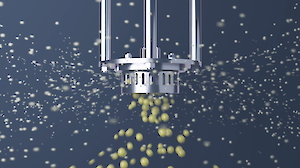 However, if you can disperse the agglomerates, rather than filtering them out, then you will get the full yield from your ingredients and reduce processing time and costs.
The key to getting your ingredients to fully disperse into your base liquid before they can form or re-form into an agglomerate is making sure that you expose the maximum surface area of your ingredient to the liquid as soon as possible.
This can be done by using a high shear rotor/stator mixer to disperse the powders into liquid.
By using a high shear mixer you can rapidly disperse agglomerates, exposing increasing areas of the solid to the surrounding liquid, resulting in an agglomerate-free dispersion within minutes.
 With a Silverson, an agglomerate-free mixture is achieved by the three-stage operation of mixer’s rotor/stator workhead. The high speed rotation of the rotor creates a powerful suction that draws the powder and liquid into the workhead. Centrifugal force then drives the materials towards the periphery of the workhead where they are subjected to a milling action in the precision-engineered gap between the tips of the rotor blades and the inner wall of the stator. The materials are then forced out through the holes in the stator and projected back into the body of the mix at high velocity, subjecting them to intense mechanical and hydraulic shear, which further breaks up the agglomerates.
This process is repeated many times in a short mixing cycle as entire contents of the vessel passes through the workhead over and over again. This progressively reduces the agglomerates in size until dispersion is complete.
Different workheads can be used to suit the materials being processed, so for example agglomerated gums and thickeners may require the scissor-like shearing action of a slotted head, while harder agglomerates may need the intense high shear provided by a square hole screen.
Where there is no longer a need to filter out agglomerates this can allow products to be reformulated to reduce the gum content and production costs.
Silverson Machines have a number of mixer options in their product range for the incorporation of powders into liquids, the selection of which is dependent on the batch size, formulation and viscosity of the end product.
If you’d like to find out more about how a Silverson mixer could help you to get rid of agglomerates in your mixing process, you can find more information on theSilverson website, or watch the Silverson Mixing Science animation ‘How to get rid of agglomerates’ which is now available to view on YouTube.
Or, if you’d like to discuss your application, please contact: sales@silverson.co.uk