Data generated by Industry 4.0 and IIoT initiatives can be used to increase efficiency and improve sustainability. By Mariana Sandin, Seeq

Following numerous net-zero pledges from companies and countries across the globe, acceleration towards decarbonization is tangible, leading process manufacturers to increase their urgency toward achieving sustainability goals and reducing their environmental impact.
Despite recognizing sustainability as an area of importance, many organizations are at a standstill in this evolving space. Due to growing regulatory, investor, and social pressures, process manufacturers know progress towards goals is urgent, but many don’t know where to begin, and how to demonstrate success. Without a clear strategy for producing measurable improvements, well-intentioned pledges are not allocated the required investment of resources and time.
But with the right Industry 4.0 solutions in their digitalisation arsenals, process manufacturers can measure their environmental performance, and then improve efficiency and thus sustainability, specifically by generating more value from time series data by leveraging advanced analytics applications.
Existing software limitations
Sustainability in the process industries is often linked to new, niche technologies, such as alternative energy and carbon capture, which are expensive to implement and maintain, and provide benefits that are not immediately realised. For example, the benefits of a wind energy farm cannot be realised until the operation balances out the carbon footprint associated with the production of each wind turbine.
When process manufactures focus solely on these technologies, they often overlook what they can do immediately to improve their environmental performance, with much less investment required. This is where operational time series data collected from IIoT projects can help.
Digitalisation and IIoT projects have been providing operational leaders with real-time access to time series data for years. Stored in process historians, this data can be analysed, with insights created and used to optimise processes.
However, as both the accessibility to and the volume of data grows, legacy software options present serious limitations when it comes to finding and operationalizing these insights. For example, many process manufacturers lack an accurate and efficient method for proactively tracking environmental performance. Instead, subject matter experts (SMEs), including process engineers and operations personnel, are left spending valuable time sorting through spreadsheets to wrangle their data, instead of analysing models and patterns that lead to useful insights.
Addressing limitations with advanced analytics
Recognizing these limitations, process manufacturers are providing SMEs with self-service advanced analytics applications, like Seeq, that provide a streamlined approach and interface for accelerating insight into process data. Advanced analytics applications enable organizations to fully leverage their workforce’s expertise to define sustainability key performance indicators (KPIs) and track performance. With these insights, SMEs can determine areas for improvement to optimise performance of existing assets.
Process experts can leverage the flexibility and agility provided by these applications to overcome previously unsolvable use cases, using a proactive approach. Driven by regulation, environmental performance has traditionally been tracked by SMEs collecting and analysing data after an event.
But by using advanced analytics applications, process manufacturers can shift from this reactive approach to a proactive, or even predictive, approach—for example by automating report generation. This near real-time visibility enables organizations to assess best practice and benchmarking more easily, while detecting deviations quickly to decrease response times and mitigate impacts.
Additionally, SMEs can build models within advanced analytics applications to better understand how process changes will improve sustainability KPIs. Using “what if” analyses, SMEs can apply these models to predict environmental performance and prevent excursions.
The following use cases show how process manufacturers are using advanced analytics applications to create insights from IIoT and other data to improve efficiency and sustainability.
Emissions reduction
One super major oil and gas company used Seeq to automate their regulatory compliance reporting. After connecting to data from various process data historians, SMEs defined and applied calculations within the application to report emissions levels accurately and efficiently, ensuring regulatory compliance (Figure 1).
The calculations and reports are automatically updated as new data becomes available in the historian, saving the oil and gas company significant time in generating these reports. And more importantly, using the advanced analytics application has empowered the company to transition from a reactive to proactive approach to identify issues efficiently, as opposed to after the fact in a monthly or quarterly report.
Energy consumption prediction modeling
A specialty chemical company wanted to develop energy models for their critical assets. Historically, creating prediction energy consumption models has been challenging for SMEs as related data is noisy, and thus difficult to model in a spreadsheet. Another issue arises because models are rarely updated, making them quickly obsolete.
By leveraging an advanced analytics application, the chemical company created prediction models using regression of the total steam demand based on equipment and instrumentation, enabling SMEs to isolate the impact of specific equipment. The application empowers SMEs to efficiently build models, in a matter of hours instead of weeks, and establish regular reviews using dashboards (Figure 2, below).
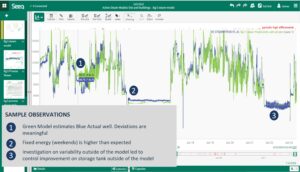
After applying the prediction models for more than three years, the company increased its steam recovery by 30% and decreased stream consumption by 15%, which equates to preventing the greenhouse gas emissions of 1,095 passenger vehicles every year.
Conclusion
Determining the best approach to address sustainability concerns does not need to be a daunting or capital-intensive task for process manufacturers. Instead, they should look at the opportunities available at their fingertips to use existing assets and resources to drive optimisation improvements.
Utilising the talent and process expertise of their existing workforce, along with Industry 4.0 solutions such as self-service advanced analytics, process manufacturers can gain more insight into environmental performance, and empower employees at all levels to directly speed progress toward attainment of sustainability KPIs.
All figures courtesy of Seeq