By integrating AI into advanced analytics workflows, users can speed up deployment, conduct more complex analyses, and increase process optimisation insights.
By Katie Pintar, Seeq Corporation

In the era of Industry 4.0, process manufacturing organisations have invested in data-driven decision-making, embracing the implementation of advanced analytics solutions enterprise-wide to gain insights into manufacturing and industrial processes.
With the launch of ChatGPT and, recently, GPT-4 to mainstream society, integrating AI to enhance many tasks, including advanced analytics workflows, has never been more popular or accessible. Applied thoughtfully, AI can amplify the impact of advanced analytics solutions by enabling complex workflows and accelerating time to value.
Amplifying SME workflows with AI-aided advanced analytics
ChatGPT/GPT-4 is a generative pre-trained transformer (GPT) model, a type of large language model (LLM). Large language models work by calculating the probability of the next letter or the next word in a sequence again and again, until a full answer to a query is produced. These models have exhibited a large leap forward for natural language tasks, and with the release of GPT-4, they are now useful in AI-assisted workflows as well.
Using ChatGPT or another leading AI platform as an assistant in the space of time series data analytics can amplify subject matter expert (SME) workflows to increase productivity and time to insight. To be most effective, both SMEs and AI tools require high-quality data, contextual information, and a platform with the flexibility to implement and operationalize insights.
Advanced analytics applications are essential to this task because they centralize data—such as process, quality, and business data—originating from disparate sources, simplifying access, creating context, and implementing live updates. Context is particularly critical for AI tools’ effectiveness in analytics workflows.
Contextualisation is key
Providing context to AI models like ChatGPT has become an important topic because many LLMs are not trained in real-time, potentially resulting in missed new information. For example, ChatGPT-4 is only trained on information on the internet up to September 2021. To provide context to models, relevant data can be included with a question—one type of embedding technique—when prompting.
Further improvements can be obtained by prompt engineering, which includes breaking down an objective into specific tasks or even providing certain phrases like “step by step” to boost accuracy. As advanced analytics applications integrate AI into their toolsets, SMEs must be able to contextualise the data before invoking Al.
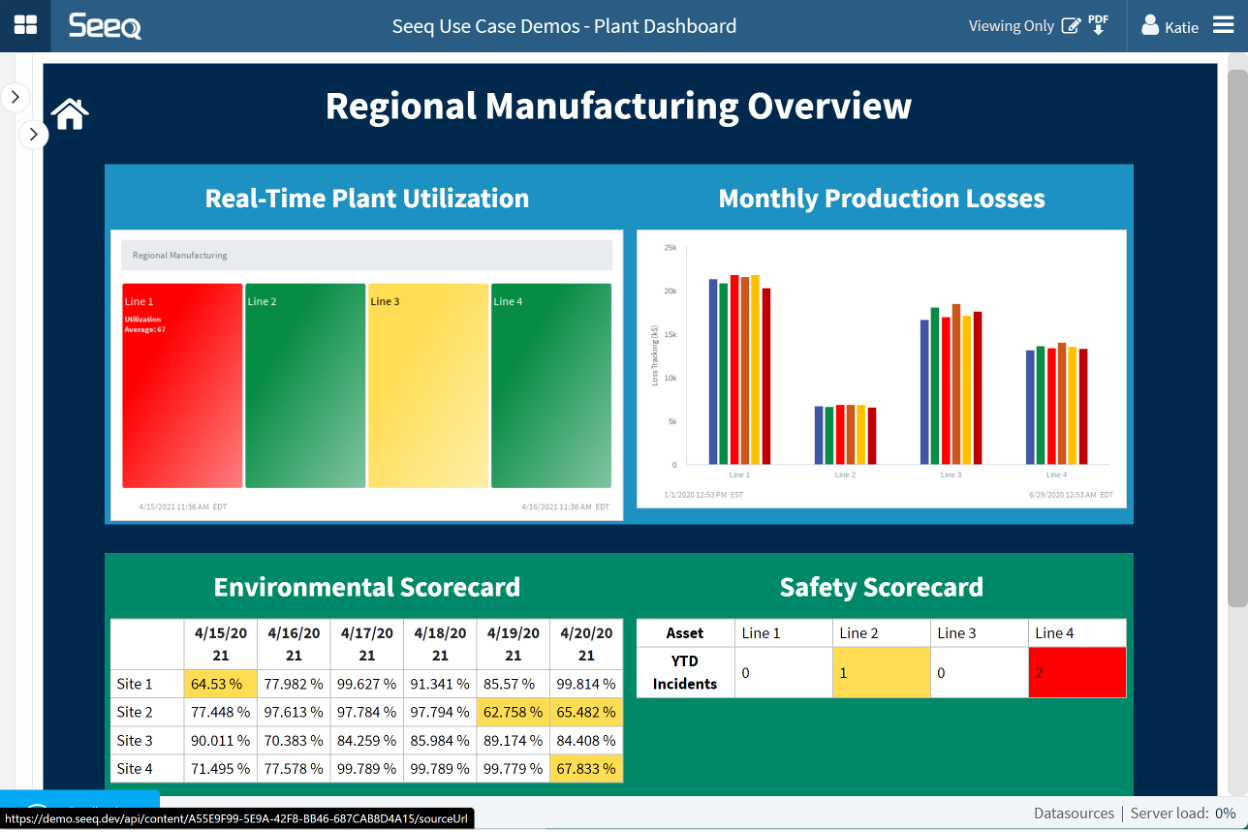
To implement advanced analytics workflows with AI input, applications need the flexibility to complete complex analyses and operationalise the results (Figure 1, above). Without flexibility, the integration of AI into advanced analytics workflows is limited, and without a way to seamlessly share and communicate the results of an analysis, the impact is minor.
Before these workflows can be truly integrated and provide value for users, companies must overcome many obstacles including costs, trust, and data privacy. Due to high compute demands, training and running models for inference can be expensive. Ineptly-tuned models can be inaccurate, or even hallucinate—making up information. And when it comes to data privacy, companies need to understand how and where data is being saved.
This is why understanding and selecting appropriate commercial vendors or open-source LLMs to integrate into system architectures is critical. The following use cases highlight practical instances where SMEs drove analysis and implementation using AI assistance.
Asset monitoring and alarm interpretation
Asset monitoring at one process manufacturing site is enabled using an advanced analytics solution to define, analyze, and organize alarm conditions, allowing operations to focus on the most critical issues. By integrating ChatGPT into the workflow, an engineer—likened to driver of a ship—leveraged it as a navigator to help sift through numerous user comments, incident reports, and work orders to summarize patterns and rapidly determine process optimisations (Figure 2).

Figure 2: A ChatGPT assistant in a Seeq alarm and event monitoring application is used to summarize patterns to help SMEs make quick, impactful process optimisation decisions.
Python code co-pilot
Leveraging Seeq, an advanced analytics solution, a user built a fully embedded tool to perform partial least squares (PLS) modelling by providing a single request to the ChatGPT model. General knowledge of the task was necessary to optimise the ChatGPT prompt and verify the code, but most coding was performed automatically by the ChatGPT model, enabling creation of the tool.
This accelerated the user’s time to value, providing a nearly seamless experience with complex workflows. Additional workflows include embedding a coding co-pilot into the Python application, enabling the SME to access ChatGPT capabilities within the application.
Identifying and creating robust KPIs
A process engineer was monitoring a controller that provides an error calculation, but they were not sure how to use percent error to create relevant key performance indicators (KPIs) to monitor and predict failures. Using ChatGPT and proper prompting techniques to provide context, they determined several appropriate KPIs and calculations, ultimately selecting “mean absolute error” for the analysis.
The engineer now calculates mean absolute error using a flexible advanced analytics solution and uses it to monitor controllers in near-real time to predict failure and monitor performance.
Optimise operations with generative AI
AI is a game-changer for process manufacturing companies wanting to amplify their analytics to unlock quicker and more impactful process optimisation. Advanced analytics solutions are often a perfect deployment mechanism for these capabilities, providing centralised data access, context, point-and-click analytics tools, process insights, and intra-organisational sharing.
Stacking AI tools atop these analytics applications can significantly speed up deployment and bridge the gap between users’ ideas and the required development work, quickly bringing analytics activities and process insights to life.
All figures courtesy of Seeq