For process automation projects, whether greenfield or the much more common brownfield, the combination of Ethernet-APL, HART-IP, and PA-DIM technologies provides the most flexible and practical upgrade path for monitoring and real-time control. By Sean Vincent, FieldComm Group
Digital transformation for industrial process automation is progressing at an accelerating pace, as ever more intelligent field devices become available. Therefore, users are looking for better ways to access and act upon the associated data so they can improve operational and asset efficiencies. 
While new projects can be designed with a clean-sheet approach for communications media and protocols, the reality remains that most projects are retrofits, or at least must interact with existing systems.As new technologies come to market, there is a transition during which not every product or product type is available in the new technology. This creates a need for blended networks. And even new projects may not be funded to initially take advantage of the very latest technologies, so designers are faced with the problem of how to incorporate essential digital technologies, while providing a practical upgrade path for improvements over time.
Process users have long been familiar with implementing HART over 4-20mA technology for bi-directional digital information exchange between smart field devices and a host system. However, there may be lingering concerns about what type of speed (bandwidth) and control features are needed in communications protocols for newer control applications, and how to transition to more contemporary Ethernet network media.
Some users may be aware of the deterministic performance goals promised by time-sensitive networking (TSN) initiatives, but it is not needed for all process automation applications. This is because virtually all process loops are thermodynamic in nature and therefore react quite slowly compared to the available network speed, and even the fastest loops can be handled by other more appropriate technologies. In fact, 4-20mA and traditional HART have always worked well in process plants, so digital technologies equaling or improving upon this speed will do so as well.
Three technologies have been developed to address these and other issues, and their intersection provides the required solutions (Figure 1, see main image above):
- Ethernet-APL has industrialized commercial Ethernet, delivering far-reaching connectivity and power for typical field devices.
- HART-IP preserves existing HART investments, extends the feature set with security and direct real-time control, and can be architected on any Ethernet media.
- PA-DIM is a protocol-agnostic information modeling specification developed collaboratively by many industry organizations, ensuring data is usable regardless of media, protocol, or field device supplier.
Together, these technologies represent a practical approach for implementing digital transformation for both existing and new systems, at the user’s preferred pace, while maintaining flexibility and protecting existing investments.
Media, protocol, data mode
Designers need to ensure that industrial communication transport media, protocols, and data models support current and future needs, especially with regards to legacy devices, and possible future devices.
Media
Traditional two-conductor 4-20mA connections are a proven workhorse technology, although many users today would prefer the capabilities offered by Ethernet. However, installing commercial-grade Ethernet in process plants requires careful consideration of drop lengths, power delivery, and environmental conditions.
These challenges are addressed by Ethernet advanced physical layer (Ethernet-APL), which is based on Ethernet standard 10BASE-T1L two-wire Ethernet, plus extensions for intrinsic safety (IS) hazardous area deployment. Ethernet-APL effectively meets or exceeds 4-20mA performance by providing a 10Mbit/s data rate with cycle times ranging from 10ms to 2,000ms, allowing up to 1,000 meters between network switches and another 200 meters to each field device, while delivering sufficient power for most instruments and even WirelessHART gateways.
Ethernet-APL doesn’t reach commercial Ethernet speeds, but it easily performs fast enough for process automation monitoring and real-time control. Standard industrial Ethernet switches are used for upper layer communications, and specific Ethernet-APL switches for the control/field network. Ethernet-APL technology uses one physical layer supporting the simultaneous interoperation of many protocols.
Protocol
Designing with a newer media might lead one to believe that a different protocol would be in order, but the situation is more nuanced when one considers that the massive installed base of HART instruments is unlikely to be ripped-and-replaced simply for a protocol upgrade.
A better option is to implement HART-IP, which remains backwards-compatible with the HART data model and tools, while providing greatly improved throughput for all industrial instrumentation and real-time control needs. HART has been popular in part because of the command data density it offers, providing significant and valuable information in just a few bytes. HART-IP continues this concept by providing efficient data payloads without the huge overhead needed by some other protocols. HART-IP is more than fast enough for process control applications, and does not require TSN or the additional effort of scheduling communications.
HART-IP works over Ethernet-APL for newer installations, but it is independent of the underlying media, so it can also work with redundant configurations, such as mesh and ring technologies, and at any network speed. HART-IP simplifies and flattens the control network, avoiding problematic data-passthrough issues (Figure 2). Multiple properly-credentialed hosts—including controllers, asset management applications, and more—can independently and securely access field devices for real-time control, measurement, configuration, and diagnostics.
Users of HART-IP retain their significant investments in HART training, knowledge, configuration, and hardware installations. Existing assets work seamlessly with new installations and can be upgraded incrementally when it makes economic and operational sense. Asset management and other tools currently using HART data can easily integrate HART-IP data since the data model is shared with HART and WirelessHART. New designs reap the full benefits of HART-IP over Ethernet-APL.
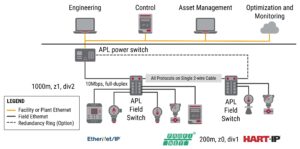
Figure 2: The HART-IP protocol operating over Ethernet-APL flattens the industrial control network, with ample performance to ensure that properly credentialed hosts can securely interact with field devices.
Data model
The third enabling technology is the Process Automation Device Information Model (PA-DIM), which is a protocol-agnostic communication specification. PA-DIM organizes automation instrument parameters to follow a structured hierarchy, ensuring instruments can be easily used among multiple software tools and protocols. Originally developed as a collaboration between OPC Foundation and FieldComm Group, there are now six additional organizations working together in the development of this standard so that machine-readable data is available for all forms of analytics and computing, regardless of media, protocol, or field device supplier. PA-DIM offers a structured data model to support monitoring, optimization, and cloud use cases while also benefitting the on-premises user with common tools for differing protocols and products.
A digital transformation path
For providing reliable industrial process digital communications, HART has long been the leading wired technology, with WirelessHART the most widely used wireless protocol. Considering the significant investment by many users in these technologies, there are many reasons for them to leverage their valuable expertise and existing applications.
Designing new and retrofit systems to use HART-IP over Ethernet-APL helps users achieve these goals. Compatibility with the PA-DIM information model takes things one step further by ensuring compatibility among the many makes and models of field devices and hosts. Together, these three technologies provide the comprehensive performance needed for today’s plants, and future-proof process operations with a digital transformation migration path.
All images supplied by FieldComm Group