In an era of water scarcity and stringent environmental regulations, industrial plant operators face unprecedented challenges in managing wastewater. With 80% of global wastewater flowing back into ecosystems untreated, efficient strategies are urgently needed. Mobile water treatment is emerging as a key solution to address these issues.
Plant operators are increasingly turning to mobile water treatment solutions to improve efficiency and reliability of wastewater treatment. Companies like NSI Mobile Water Solutions, part of Nijhuis Saur Industries, are helping sites safeguard operational licences while lowering their environmental footprint.
When Go Mobile?

Mobile wastewater solutions offer flexibility and efficiency in various scenarios. In emergency situations, they can quickly address equipment failures or unexpected contamination events, ensuring minimal disruption to operations. During periods of increased production or seasonal fluctuations, these solutions can provide temporary capacity increases, allowing plants to manage spikes in wastewater volume without permanent infrastructure changes.
For companies considering new treatment technologies, mobile units offer an excellent opportunity for pilot testing before full-scale implementation. This approach minimises risk and allows for fine-tuning of processes. During planned maintenance of permanent facilities, mobile solutions can step in to support ongoing operations, preventing costly downtimes. Additionally, as regulatory standards evolve, mobile units can help companies rapidly adapt to new discharge requirements, ensuring continuous compliance.
Benefits of Mobile Wastewater Solutions
One major advantage of mobile water treatment solutions is financial flexibility. Pay-as-you-go contracts, ranging from 1 day to 7 years, allow for predictable payments, which improves financial planning. This model enables companies to manage water treatment costs as operational expenses rather than large capital investments.
Another key benefit is rapid deployment. In urgent situations, mobile units can be quickly installed and operational, bypassing the lengthy processes associated with permanent installations. These systems also offer scalability, allowing companies to adjust treatment capacity as needs change. By providing access to the latest wastewater treatment technologies without significant capital investment, mobile solutions meet diverse and evolving operational requirements.
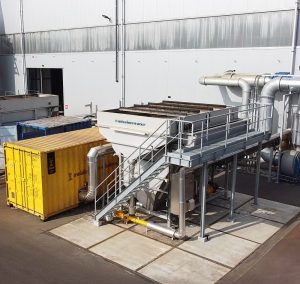
Since joining Nijhuis Saur Industries in December 2022, NSI Mobile Water Solutions has developed one of the largest and most versatile fleets in Europe for treating both process water and wastewater. Notable among its offerings is the IPF/ICF range—a compact, containerized system for industrial wastewater pretreatment (with or without flocculation) that supports flow rates from 2 to 135 m³/h. Each unit is equipped with essential components, including a feed pump, chemical container, dissolved air flotation (DAF) system, and a sludge pump.
With ongoing advancements in treatment technologies, such as advanced membrane filtration, mobile units provide companies with the flexibility to upgrade processes easily. These advanced technologies enable the transformation of wastewater into high-quality reusable water, supporting circular water management practices and enhancing sustainability.
Case Study: German Refinery Embraces Mobile Water Solutions
A refinery in north-west Germany partnered with NSI Mobile Water Solutions to address regional water scarcity and comply with stringent discharge regulations. Two innovative projects were implemented to enhance the sustainability of the refinery’s operations.
The first project focused on the reuse of reverse osmosis (RO) concentrate. By optimising the treatment process using two mobile reverse osmosis units, the refinery was able to achieve lower conductivity levels in the concentrate. This improvement maximized permeate production, effectively reducing waste and increasing the amount of high-quality water fed back into the refinery’s system.
The second project tackled the reuse of wastewater from the refinery’s on-site wastewater treatment plant (WWTP). This initiative integrated advanced ultrafiltration technology with upstream NaOCl dosing and downstream Activated Carbon filtration. Complemented by a mobile reverse osmosis trailer, this system allowed the refinery to repurpose a significant portion of its WWTP effluent.
These achievements not only aligned with stringent environmental standards but also supported the company’s corporate “water positive” initiatives.
Conclusion
NSI Mobile Water Solutions offers a flexible, efficient, and cost-effective approach to wastewater management. With one of the largest mobile water and wastewater fleets, numerous depots, and a dedicated team across Europe, NSI Mobile Water Solutions presents itself as the partner of choice for industrial plant operators looking to leverage the expertise of Nijhuis Saur Industries in wastewater treatment.
By embracing mobile wastewater treatment and reuse technologies, companies can ensure compliance and operational continuity while reducing their freshwater consumption and environmental impact.
For more information about NSI Mobile Water Solutions, please visit:
https://www.nsimobilewatersolutions.com/
mws@nijhuisindustries.com