Official UK Iwaki distributor says many dosing problems originate in the wider system, from suction conditions and pipework to leak management, access and documentation.
Chemical dosing systems rarely fail at the pump alone, according to Sensys, the official UK distributor for Iwaki.
The company is encouraging process engineers, maintenance teams and technical specifiers to assess the full dosing installation when handling aggressive, hazardous or difficult-to-handle liquids.
Across chemical processing, food and beverage, water treatment, pharmaceutical manufacturing, semiconductor production and wider industrial applications, chemical dosing may support pH correction, cleaning, chemical transfer, wastewater treatment, emissions control, process utilities or controlled chemical addition.
While pump selection remains critical, Sensys says many dosing issues are caused by the wider installation around the pump.

Dominic Murdin, CEO at Sensys, said: “When a dosing system becomes unreliable, the pump is often the first thing people look at. But in many cases, the root cause sits elsewhere in the system. Suction conditions, discharge restrictions, injection points, pipework materials, valve positions, leak management, controls, access and documentation all influence how safely and reliably a dosing point performs.”
Chemical dosing systems can be affected by multiple failure points across the full installation. On the supply side, issues can include low or empty chemical containers, incorrect chemical connection, changes in concentration, crystallisation, contamination, off-gassing, poor venting or inadequate containment around chemical storage.
On the suction side, common problems include air ingress, blocked strainers, loss of prime, poor suction lift, vapour locking, collapsed tubing, leaking fittings or incompatible materials.
The pump itself can also be affected by blocked heads, diaphragm wear, valve ball or seat wear, incorrect sizing, unsuitable wetted materials, poor turndown, incorrect calibration or chemical attack.
On the discharge side, reliability can be affected by blocked injection points, excessive back pressure, siphoning, failed injection valves, lack of pressure relief, pulsation, leaking fittings or restricted pipework.
Dominic added: “A dosing fault may present as a pump issue, but the cause can be a blocked injection point, poor suction arrangement, unsuitable material, closed valve, missing pressure relief route or incorrect control signal. That is why chemical dosing should be treated as a complete system, not a pump-only decision.”
Sensys says the challenge is often made worse as dosing systems evolve over time. Components may be added, replaced or adapted to solve immediate problems, but the resulting installation can become harder to inspect, maintain and standardise.
Unclear flow paths, exposed pipework, undocumented modifications, poor access, missing P&I diagrams, limited spare parts and reactive maintenance practices can all make dosing points more difficult to manage over the life of the installation.
Human factors can also contribute, including incorrect chemical changeover, manual valves left closed, alarms being muted or bypassed, calibration being skipped, or contractors being unfamiliar with the system.
Dominic said: “A dosing point can work perfectly well on day one but become harder to manage over time. If drawings are out of date, pipework has been modified, access is poor or valve positions are unclear, maintenance teams are left dealing with unnecessary complexity.”
Sensys is encouraging operators to assess chemical dosing points as complete chemical-handling systems. This means considering the chemical, concentration, suction conditions, discharge pressure, pipework materials, valve arrangement, leak management, access, controls, alarms, documentation and maintenance requirements as part of the same specification.
 As the official UK distributor for Iwaki, Sensys supports customers with Iwaki Systems for safer and more controlled handling of aggressive liquids. The Iwaki Systems range includes dosing cabinets, safety cabinets, mobile units, process units, process equipment and basic safety products, allowing customers to consider dosing, transfer, containment, mobility and operator protection as part of a wider system approach.
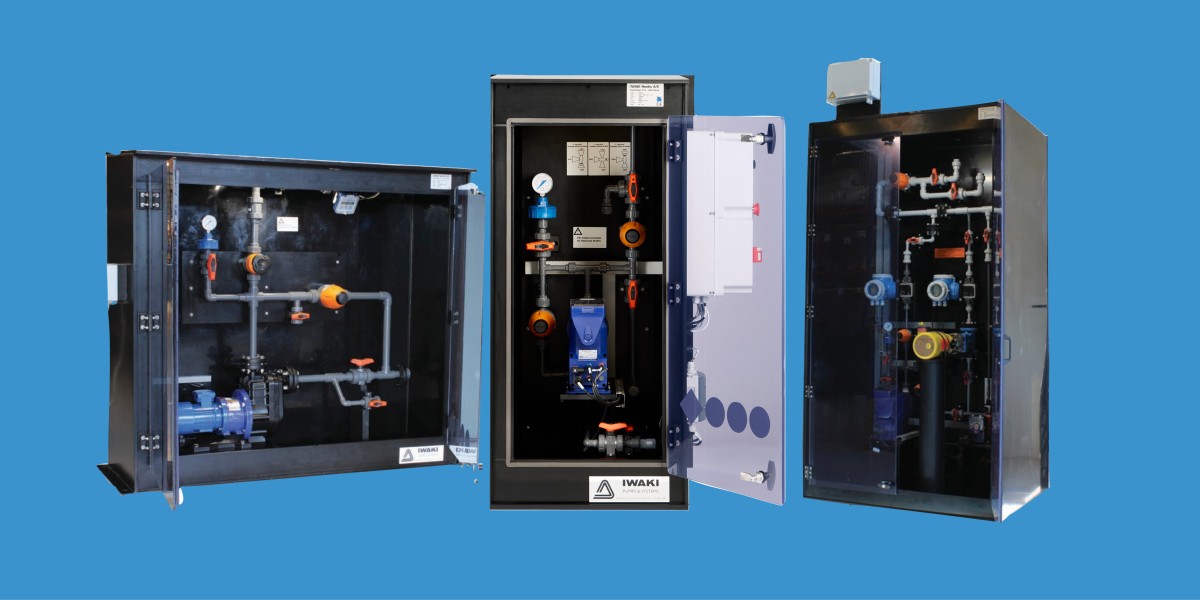
Iwaki dosing cabinets are one example of this approach. They bring pumps, pipework, valves and fittings together within a defined cabinet arrangement, helping create a cleaner, more orderly and more accessible dosing point.
Standard cabinet details can include transparent PVC doors, PE cabinet materials, PVC-U pipework and valves, internal lighting, service switch provision and CE marking, depending on the configuration.
For leak management, Iwaki dosing cabinets are fitted as standard with a sump outlet port in the bottom wall, with a short section of pipe and an external ball valve fitted beneath the cabinet. This allows any collected leakage within the cabinet to be drained and managed as part of the wider site containment and operating procedure. Where required, a level sensor inside the sump can be specified as an optional extra, with alarm or signal integration considered as part of the wider system design.
Dominic added: “The value of a cabinet-based system is not simply that it puts a pump inside a cabinet. It gives the dosing point a defined structure. That can improve visibility, support maintenance access and reduce reliance on fragmented site-built arrangements.”
The Iwaki Systems range is structured around Standard, Standard+ and Engineered options. Standard systems provide a proven starting point for common duties. Standard+ options allow selected adaptations such as mirrored connections, flange connections or alternative cabinet and pipe materials. Engineered systems support more specific requirements such as additional instrumentation, alternative materials, complex cabinet layouts or application-specific designs.
For process operators, this flexibility matters because dosing requirements vary by chemical, duty, location and operating environment. Applications may include acid and alkali dosing, additive and inhibitor dosing, CIP chemical dosing, scrubber systems, boiler and cooling water treatment, wastewater neutralisation, pH correction, disinfection and treatment chemical dosing.
Documentation is also part of the system approach. Iwaki standard system documentation can include declaration of conformity, instruction manuals, P&I documentation, CAD drawings, electrical diagrams, hydrostatic test reports, pump documentation, component manuals and datasheets.
Dominic concluded: “The key question is not simply, ‘Can this pump dose the chemical?’ It is, ‘Can the full dosing system handle the chemical safely, reliably and in a way that can be inspected and maintained over time?’ That is where a systemised approach adds real value.”
Sensys has developed a practical guide and specification template to help UK customers assess when a dosing cabinet or wider system solution may be appropriate, and what information should be considered before specification.
For more information about Iwaki dosing cabinets and system solutions, visit www.sensys.co.uk/sensys_accessories/cabinets/ or contact Sensys on 01438 759595.