Less is more
Measurement and control technology is the backbone of every process technology system. The centrally installed marshalling and interface components, however, take up a large amount of space in the control room. Therefore, Phoenix Contact is constantly reducing the overall width of its products, so that up to a quarter of control cabinets can be saved.

Based on the size of the system, a continuous process requires between 5000 and 25,000 sensors and actuators for being controlled. One option is to use remote I/Os. These are distributed in the field and installed in a terminal box. The sensors and actuators are then connected to the remote I/Os as binary or analogue signals. Connection to the control system is performed via PROFIBUS/Modbus ring structures or, on some cases, PROFINET ring structures.
Alternatively, fieldbus systems can be used, devices must be provided with a PROFIBUS PA or FOUNDATION Fieldbus (FF) interface. In the field, twelve to 24 field devices are connected to field barriers and device couplers. Then connected to the FF master or DP/DA coupler via main fieldbus lines. The signals can also be transmitted using classical parallel wiring.
Up to 60 control cabinets for signal conditioning and marshalling
In spite of Cloud Computing, Predictive Maintenance, and Augmented Reality, the majority of operators still uses parallel wiring and central control for large systems.. But unfortunately, parallel wiring takes up most space in the control room.

Figure 1 – Schematic MCR technology layout in large systems
Control rooms house different cabinet types (Figure 1). System cabinets where the I/O cards of the control systems are installed. Interface cabinets include relays, signal isolators, and surge protection devices, if required, are used for decoupling, Ex isolation, and for protecting the application against transients and high-energy voltage peaks. Marshalling cabinets are used for structured connection of the field cables, and for cross marshalling towards the correct interfaces.
IEC 61511 consideration
The current updates of IEC 61511 result in continuous reassessment of the system safety classification, which in turn can lead to a rising number of SIL circuits and safety controllers
Housing width reduced by about 60 percent
Phoenix Contact has set the goal of steadily reducing the housing dimensions of all the key products so that the number of interface and marshalling cabinets required by the user is reduced. The two-channel signal conditioners of the MACX product family as an example, have an overall width of only 12.5 millimetres, are certified according to SIL 2 and SIL 3 and have passed the NAMUR NE95 type test. Equivalent devices of older series only have one channel and a width of 17 to 20 millimetres. This results in space savings of about 60 percent.
A SIL 3 coupling relay of the PSRmini product family features a housing width of only 6.8 millimetres. The module comprises two elementary relays each with two force-guided contacts, and is designed for high-demand and low-demand applications. Compared to the equivalent coupling relays more than 17.5 millimetres wide, the space requirements have lowered by more than 60 percent.
Thanks to Push-in connection technology, the overall width of the knife disconnect terminal blocks of the PTTB 1,5 MT product family was reduced to 3.5 millimetres, for conductors with a cross-section of up to 1.5 square millimetres. Compared to previous knife disconnect terminal blocks at more than five millimetres, 70 percent less space is required.
Don’t forget surge protective devices for measuring and control signals with a width per channel of five to twelve millimetres. With the TERMITRAB complete series, Phoenix Contact has reduced the overall dimensions to 3.5 millimetres.
 Thanks to the large number of narrow products, the components from Phoenix Contact can be used to implement new control cabinet concepts. Combined interface/marshalling cabinets can be designed, for example, that ensure intrinsically safe isolation and marshalling of a system with 10,000 I/Os in less than 30 standard control cabinets (800 x 2000 millimetres) – including an additional free space of ten percent (Figure 2).
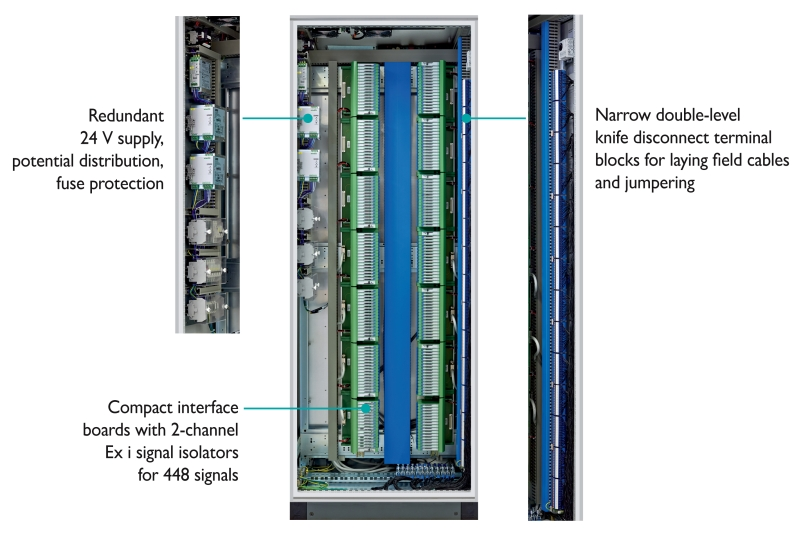
Figure 3 – Marshalling/interface control cabinet combination for up to 448 signals
Protection of 572 signals on one meter of DIN rail
With an overall width starting from 3.5 millimetres, the TERMINTRAB complete product family offers particularly narrow surge protective devices (Figure 5). They are suitable for all MCR applications. This means that the protective devices can protect up to 572 signals against surge voltages on just one meter of DIN rail.

Figure 5 – TERMITRAB complete provides surge protection on an overall width from 3.5 millimetres
Optional remote signalling modules monitor the status of up to 40 neighbouring surge protective devices The surge protective devices are available with Push-in connection technology as well as with screw connection technology. Versions with innovative knife disconnection and for Ex applications are also available.