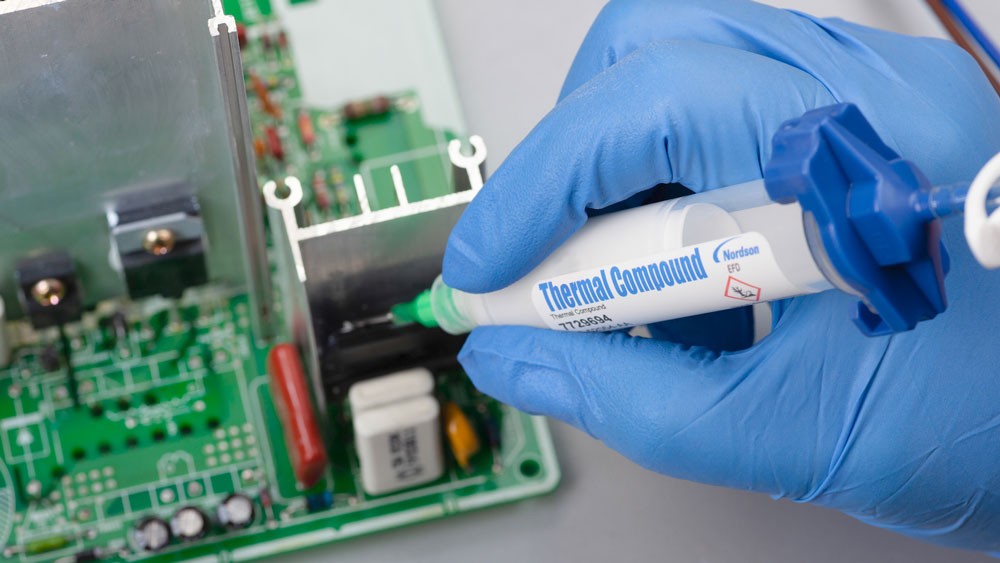
As the automotive industry evolves into a “smartphone on wheels,” the integration of electronics has surged, with estimates indicating that electronics now account for 40% of a vehicle’s value—projected to reach 50% by 2030. This rapid increase in electronic components, including control units, wiring, and sensors, has heightened the importance of effective thermal management to ensure safety, reliability, and optimal performance. Thermal interface materials (TIMs), such as pastes, gels, and greases, are critical in this regard, facilitating heat dissipation from high-power devices like LED headlights, ECUs, and EV batteries.
The Challenge of Dispensing Thermal Interface Materials
 TIMs are often filled with abrasive particles or fillers, making their application a complex task. Their viscosity varies, and their particulate nature can cause wear and tear on dispensing equipment if not properly selected and maintained. Precise, consistent application is essential—not only to prevent overheating and component failure but also to minimize waste and over-application, which can compromise device performance and longevity.
Why Precision Dispensing Matters
In applications ranging from LED lighting to EV battery modules, the quality of thermal paste application directly impacts component lifespan and safety. For example:
- LED Headlights and Taillights: Proper application of thermal pastes ensures effective heat removal, maintaining brightness and lifespan.
- Electronic Control Units (ECUs): Accurate thermal management protects critical electronics like airbags and braking systems.
- EV Batteries: Precise application of TIMs ensures efficient heat dissipation, contributing to battery safety and performance.
Achieving this level of accuracy requires specialized, reliable dispensing equipment capable of handling abrasive, viscous materials while maintaining consistent deposit volumes.
Advanced Dispensing Solutions: The Role of Progressive Cavity Pumps
Nordson EFD’s 797PCP series progressive cavity pumps are engineered to address these challenges. Their unique design features a sealed metering chamber that handles shear-sensitive, abrasive TIMs without crushing fillers, ensuring the preservation of material properties. These pumps deliver volumetric accuracy within ±1%, providing highly repeatable deposits essential for quality control.
Benefits for Automotive and Electronics Manufacturing
- Reliable, Repeatable Dispensing: The pumps maintain consistent volume and flow rates, reducing variability in heat sink and ECU assembly.
- Handling Abrasive Materials: Tungsten carbide components resist wear from fillers, extending equipment lifespan.
- Precise Ratio Metering: For two-part TIMs, the pumps accurately dispense the correct mix ratios, critical for effective thermal management.
- Modular Design: Easy to replace internal components minimizes downtime and maintenance costs.
Automated Dispensing for Complex Geometries
In high-volume manufacturing, automation enhances throughput while maintaining precision. Nordson EFD’s EV Series automated robots and gantry systems integrate seamlessly with PCP pumps, enabling complex, repeatable patterns—such as covering irregular surfaces or large areas on battery modules—while ensuring minimal waste.
Recent innovations include the ability to convert CAD files into dispensing patterns, simplifying setup and reducing programming time. Automated systems also incorporate vision-guided technology, ensuring perfect alignment and deposit accuracy in tight spaces.
Managing Abrasive TIMs: Choosing Between Auger Valves and Progressive Cavity Pumps

The choice between auger valves and progressive cavity pumps hinges on the material’s viscosity and abrasiveness:
- Auger Valves: Suitable for high-throughput, viscous, low-abrasion TIMs. Their tungsten carbide screws resist wear and are ideal for single-part pastes, but they are less effective with low-viscosity or highly abrasive materials.
- Progressive Cavity Pumps: Offer precise volumetric dispensing for both one-part and two-part TIMs, including highly abrasive, shear-sensitive compounds. Their sealed chambers prevent shear degradation, preserving filler integrity, and their modular design allows for easy maintenance.
For two-part TIM applications, such as those used in EV batteries or advanced driver-assist systems, PCP pumps with static mixers provide accurate ratio dispensing and consistent coverage, critical for thermal management.
Ensuring Consistency and Quality
The success of thermal paste application depends not only on equipment choice but also on proper handling and preparation. Nordson EFD emphasizes the importance of thorough degassing to eliminate entrapped air bubbles in TIMs, which can lead to voids and reduced heat transfer efficiency.
Conclusion
As electronic components become more integrated into vehicles and consumer electronics, effective thermal management through precise dispensing of TIMs is more critical than ever. Advanced equipment like Nordson EFD’s progressive cavity pumps and automated dispensing systems enable manufacturers to achieve high-quality, consistent applications—protecting sensitive electronics, extending device lifespan, and ensuring safety. Whether managing heat in LED headlights, ECUs, or EV batteries, leveraging the right dispensing technology can significantly enhance the performance and reliability of your electronic systems.
Discover how Nordson EFD can transform your operations today by visiting nordsonefd.com and taking the first step towards mastering your production lines.
Nordson EFD | Fluid Dispensing Solutions – Electronics Industry