By Imeshika Korale, ProdX™ Product Lead, Mettler Toledo
Ask artificial intelligence (AI) to find a pattern in a thousand perfectly organised production records and it may spot something a human has missed. Ask it to make sense of information scattered across machine interfaces, spreadsheets, USB sticks and local systems, and the challenge is very different.
That is the less glamorous reality behind much of the excitement surrounding AI in food manufacturing. While the conversation focuses on predictive maintenance, automated compliance and production lines that learn from experience, AI still needs something reliable to learn from. For many manufacturers, the first challenge is not finding a smarter algorithm. It is bringing their data together.
Pressures on manufacturers are continuing to increase. Rising material costs, labour shortages, stricter compliance requirements and growing expectations around productivity are forcing businesses to make better use of the information already available to them. As AI tools become more accessible, the quality and availability of operational data is becoming a competitive differentiator.
Checkweighers, metal detectors, and x-ray systems already generate huge amounts of valuable inspection information. Yet each device may only see one part of the production process. Without a way to connect those records, it can be difficult to understand what is happening across a product, line or site, let alone identify the subtle patterns that could point to waste, equipment problems or process inefficiencies.
First, give the factory a memory
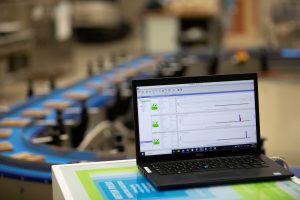
This is where data management software comes into the AI story. Solutions such as ProdX™ from Mettler Toledo can centrally collect and structure product inspection data, creating a continuous record of rejects, performance tests, alarms and product settings. Events can be linked with timestamps, device IDs and product IDs, giving manufacturers a clearer history of what happened, where and when.
The difference is context. One record showing that a pack was rejected offers limited insight. A history showing which products were rejected, on which devices, during which shifts and alongside changes in inspection performance can begin to reveal a pattern.
ProdX™ is not the AI. Rather, it creates the data environment in which AI can be more useful. Instead of trying to reconcile disconnected exports or incomplete records, analytical tools can examine a wider production history and look for relationships that may be difficult to identify manually. The question moves beyond what happened to what keeps happening, and why.
When an extra gram becomes a clue
Consider a ready-meal manufacturer experiencing inconsistent overfill. A checkweigher can identify that packs are running heavy, allowing production teams to adjust the filling process. If the issue repeatedly returns, however, the same reactive corrections may be made without anyone understanding the underlying cause.
When weight distributions are continuously captured and connected with product, time, line speed and available upstream information, a more complete picture emerges. In one example, AI analysis identified a relationship between periods of overfill and slight changes in sauce temperature during particular shifts. Suddenly, the weight of the pack was not simply a problem to correct. It was a clue. The analysis pointed towards temperature control or filling parameters as areas for investigation, giving the manufacturer a potential process cause to address rather than repeatedly reacting after giveaway had occurred.
In today’s manufacturing environments, AI-driven analysis can reveal relationships that would be difficult to identify through manual review alone. Data management provides the connected inspection history. AI can interrogate that history for anomalies, correlations and recurring patterns, helping production teams understand where to look next.
Small patterns can carry a big cost
The value of AI in manufacturing is often framed around dramatic automation projects, but some of the biggest opportunities may be hidden in small deviations repeated at scale. A few unnecessary grams multiplied across millions of packs can become substantial giveaway. A gradual increase in false rejects can create waste before anyone notices the trend, while recurring line stops add downtime, rework and scrap.
Structured inspection data gives AI the foundation to examine where these losses are occurring. Analysis might identify that overfill is concentrated around particular products or production conditions, that one shift experiences a higher level of false rejects, or that a gradual change in inspection performance could indicate a developing equipment issue.
The same principle applies to compliance. Quality teams can spend significant time collating logs, local reports and spreadsheets for audits or investigations. With inspection activity held in a central record, AI has the potential to monitor compliance patterns, highlight missed or late tests and draw attention to unusual configuration changes. The saving may therefore be measured in product, downtime, and hours spent finding and compiling information.
AI can interpret the data. It cannot invent trust.
For manufacturers considering data management and AI, concerns around integration, cybersecurity, disruption and return on investment are understandable. There is also a more fundamental question of trust. If an AI tool highlights a risk or suggests that a process should be investigated, teams need confidence in the information behind that conclusion. AI systems may identify correlations, but they cannot determine whether underlying records are accurate, complete or correctly captured. Poor-quality data does not produce better decisions, it simply enables faster, more confident mistakes.
Creating trust in AI therefore begins with creating trust in the underlying data. Data management software should be able to maintain structured inspection information in which activities can be time-stamped and connected with products, devices and users. It is also imperative that records are stored centrally in a tamper-proof environment. AI will analyse and interpret that information, but the original inspection history remains available and traceable.
Perhaps the future of data management is therefore not AI replacing existing systems, but data management becoming the foundation that makes AI genuinely useful. The factory does not need to think for itself. It needs a reliable memory and better tools for understanding what that memory is telling it.
Sometimes, the first sign of a much bigger production story might be nothing more than an extra gram of sauce. Before investing in more AI tools, consider whether your production data is ready to support them. A strong data foundation may be the most important step on the journey to smart manufacturing.
Discover why leading manufacturers are prioritising data quality, connectivity and traceability as essential building blocks for future AI initiatives by clicking here or visiting: www.mt.com/prodx-pr.