Recent evolutions in technologies and market trends dictate that automation will underpin a vast majority of operational processes as manufacturers take steps to meet demand and remain competitive, with a focus on both product throughput and quality output. But not all processes within a process chain can be automated; human dexterity will always have the upper hand (no pun intended). Robotics are renowned for undertaking repetitive, unsafe or non-ergonomic tasks and can do so 24/7 and provide an operation with significant benefits. But how do we strike the balance between robotic process automation and essential manual processes versus product throughput and quality output?
Collaborative robotics provide value where operations can’t be completely automated. These applications incorporate an automated robotic element as a means to undertake repetitive tasks, assisting a worker, not replacing them. They are designed with human safety as a key priority and are smarter than your average industrial robot, designed to undertake complex tasks and are more often than not equipped with smart technologies that make them people aware.
Collaborative robots, or cobots, are relatively easy to implement within an existing working environment. They require no guarding or costly fencing and their small footprint dictates that they are able to occupy compact spaces ensuring that business owners are able to best utilise existing floor space. Joint torque sensors enable some collaborative robots to detect contact immediately and reduce its level of force and speed instantly. Position and compliance controls enable some to handle delicate components for delicate assembly work.
But we shouldn’t think of the collaborative robot as a static element. Imagine the combined strengths of both a sensitive robot and an autonomous, mobile platform; an entirely new means of autonomous, highly flexible working methods to optimise your production – the perfect basis for meeting the requirements of industry 4.0.
So exactly what are the benefits of working with collaborative robotics?
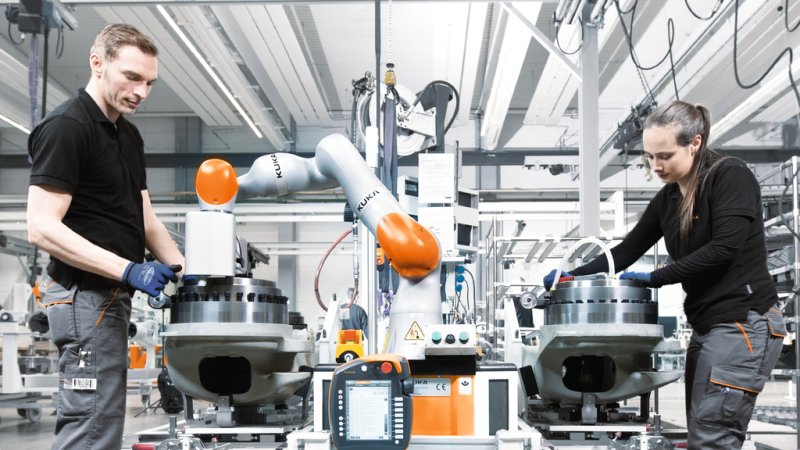 Increased efficiencies is the first and most obvious benefit that can be afforded through the adoption of collaborative robotic processes. A recent case study from KUKA highlighted just how an operator can collaborate fully with a seven axis robotic arm and share tasks within an assembly process. The application provided the automotive client with reduced cycle times, enabling the operator to attend to other processes within the manufacturing production line. Ultimately providing an increase in product throughput.
An increase in return on investment. Through increased productivity and a reduction in manual labour costs. Collaborative robots can be positioned next to their human co-workers eliminating the need for barriers to work around which can present a loss in hours.
Minimal impact upon the human environment. The ability to employ collaborative robots into an environment where humans operate provides an enhanced level of operational efficiency to business owners. Installing robots, removing robots or deploying humans within one central work space supports flexible working practices especially so for low volume high-mix manufacturers.
Safety and complexity considerations. There are certain applications that are simply not suited to humans or traditional robots. Consider the use of surgical instruments where precision and accuracy are paramount. KUKA’s LBR iiwa medical variant collaborative robot as a prime example. In this instance humans are reliant upon the collaborative robot to assist in improving complex or critical techniques and procedures.
As a means to future proof your operations. Flexibility and adaptability are key to the success of any business. Collaborative robotics empower business owners and enable changes to an operational process to take place at the drop of a hat. The ability to optimise your operations will stand you apart from your competitors. Collaborative robot arms can be deployed quickly without interference with your production lines.
Collaborative robots are redefining human/robot relationships across a number of industries as manufacturers look at ways in which they can improve their operations to align with lean manufacturing principles. As the supply versus demand balance starts to shift we can expect to see collaborative robots become mainstream.
As a pioneer and driver of innovative automation solutions, KUKA do not define our standards by what already exists, but rather by the needs of the future; sensitive, lightweight, scalable robotics for every production area. Designing automation to be even more intuitive and introducing it into new areas.