Kevin Fernandes, Process Analytics Sales Engineer, Endress+Hauser Ltd
Kevin Fernandes, Process Analytics Sales Engineer for Endress+Hauser Ltd, discusses applications for Raman spectroscopy in carbon capture and hydrogen analysis.
As the world looks to cut greenhouse gas emissions, carbon capture and the production of low-carbon hydrogen have critical roles to play. Carbon capture permanently removes CO2 produced by industrial processes or burning fossil fuels from the atmosphere and stores it underground. Increased use of hydrogen as a fuel, on the other hand, prevents carbon emissions at the outset because hydrogen emits only water when burned or used in a fuel cell, although the production process can release carbon.
Carbon capture requires careful monitoring for process control and optimisation as well as reducing total costs of ownership and safety risks. Chemical absorption based on amine solvents is considered to be the most mature technology and commercially feasible method for carbon capture. Key to optimising this process is solvent management, including CO2 loading and amine strength, and Raman technology from Endress+Hauser offers a fast and robust solution.
Process optimisation
Raman technology has numerous benefits for carbon capture. The first is replacing time-consuming off-line analysis such as titration (more than two hours for sample preparation and measurement) with in-line monitoring, which gives measurement results in less than one minute without human interference. As well as reliably predicting the total CO2 and amine concentrations in changing process conditions, Raman monitors the variation of solvent quality and degradation, thus minimising solvent loss, and the performance of the absorber, desorber and other equipment. All this minimises downtime for the carbon capture plant and enables plant operators to optimise their processes.
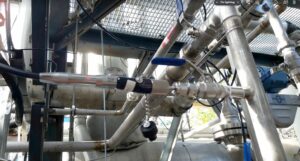
In line chemical analysis of amine process stream by a Raman immersion probe
Utilising hydrogen
Hydrogen can be produced from natural gas or even coal with virtually no greenhouse gas emissions by trapping the resultant CO2 underground. Even more environmentally friendly is so-called green hydrogen generated by electrolysis, where excess electricity can be channelled into an on-site installation that breaks water into its components, hydrogen and oxygen. This produces no carbon emissions but is an expensive process.
Blending green hydrogen with natural gas is a way to generate heat and power with lower emissions than using natural gas alone. These blends can be used for on-site consumption or sent out into the existing gas grid. Every incremental amount of hydrogen injected into a natural gas fuel system or pipeline abates a quantity of methane, and therefore CO₂.
Hydrogen is highly combustible, and blending hydrogen with natural gas poses an increased risk of explosion. Hydrogen also has a volumetric heating value approximately one-third that of methane due to its low density, which means limits have to be imposed by gas producers and pipeline companies on the permissible volume to avoid reducing the overall heat value too much. Users such as gas turbine operators are particularly concerned about this since diluting heat value has a direct effect on a turbine’s horsepower output. With maximum blending amounts influenced by these performance and safety concerns, being able to accurately measure how much hydrogen has been mixed into the stream is vital.

Gas tap with pipeline system at natural gas station.
Real-time measurement
Endress+Hauser’s Raman Rxn5 analyser delivers real-time, reliable composition analysis of rapidly changing gas turbine fuels blended with hydrogen by taking simultaneous readings from up to four probes located in different parts of the process stream. Together, the Raman analyser system provides calculations of the Wobbe index – a reference used to compare the energy output of different gas blends. The Wobbe index is critical when using alternative fuel sources like hydrogen which has a lower Btu per volume than natural gas. Reliable, nearly instantaneous feedback about the integrity of the gas blend helps to prevent too much hydrogen being added, which could damage the combustion system. In addition to hydrogen content, a Raman analyser can also handle many of the commonly measured natural gas components. As the probe is located remotely from the analyser, there is no need for the operator to handle a sample, enhancing safety.
With the potential for four-channel availability and fibreoptic lengths up to 150 metres, a Raman analyser can also monitor hydrogen composition over a long length of pipeline after being injected. This data can be used to monitor the mixing quality or to corroborate predictive models of how hydrogen will behave in the gas grid at scale. This is especially useful for gas utilities looking to meet renewable gas portfolio standards in their distribution networks, without compromising safety or quality for their customers and other stakeholders.

Rxn5 process analyser validates the gas blend
When combining Raman spectroscopy with a comprehensive control strategy, companies can maximise the use of carbon capture and hydrogen without compromising safety or efficiency, ultimately reducing overall carbon emissions for a sustainable future.
Contact details:
Kevin Fernandes
Process Analytics Sales Engineer
Endress+Hauser Ltd.
Floats Road
Manchester
M23 9NF
Tel. +44 161 286 5000
info.uk@endress.com
www.uk.endress.com