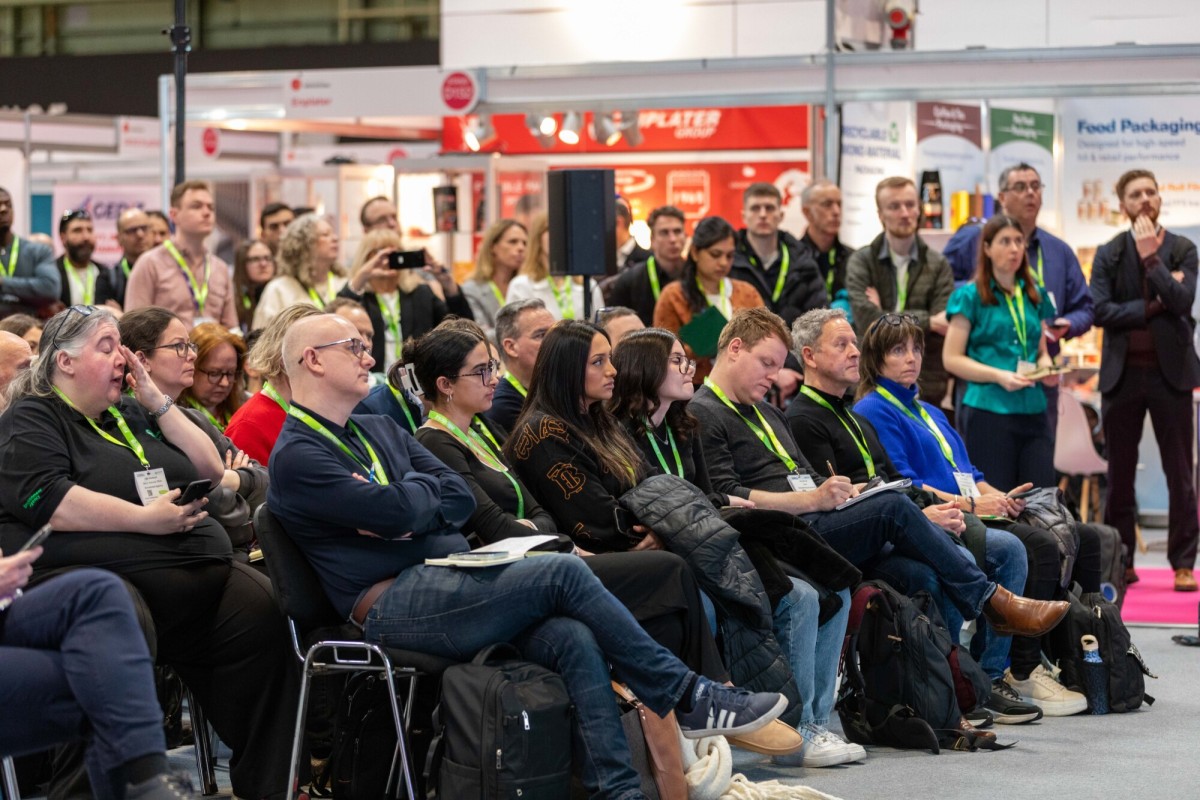
From AI failures and circular economy setbacks to QR codes at checkout and the realities of modern manufacturing, industry leaders will confront the challenges of turning packaging innovation into action.
Packaging Innovations & Empack 2027 has unveiled the first speakers and sessions for its conference programme, bringing together global brands, technology leaders and industry experts to address the commercial, creative and operational challenges facing the packaging industry.
Taking place at the NEC Birmingham on 24 & 25 February 2027, the event will feature senior figures from PepsiCo, Mars, Siemens, Greencore and Tesco, alongside the Founder of the Museum of Failure. Under the theme ‘Innovation in Practice’, the conference will tackle the gap between ambition and execution, from circular packaging models that struggle to scale to the risks of AI-generated design and the production inefficiencies that new machinery alone cannot solve.
Vinicius Sales, Global Design Lead at PepsiCo, will take delegates behind the scenes of packaging innovation. In his keynote, ‘More than a can: Designing packaging that performs, surprises and endures’, Sales will explore how global brands, including Pepsi, Gatorade, 7Up and Mirinda, can push creative boundaries, embrace new technologies and evolve their packaging while protecting the identities consumers recognise and trust.
But not every innovation delivers on its promise. Dr. Samuel West, Founder and Curator of the Museum of Failure, will tackle the rise of ‘AI slop’ in ‘AI: When innovation goes wrong’, highlighting the risks of AI-generated designs that are convincingly presented but fundamentally flawed, creatively hollow or spectacularly off-brand. Meanwhile, Nicki Morley, Global Managing Director of Innovation Solutions at Kantar, will join the panel ‘What makes it onto the shelf? Turning consumer insight into packaging that sells’, challenging the disconnect between what shoppers say they want and what they actually buy.
Even the smallest packaging changes can have consequences far beyond the finished pack. Jane Skelton, Head of Packaging & Creative at Nichols, will reveal how a Vimto redesign became a business-wide exercise in negotiation and problem-solving in ‘One Vimto, many priorities: The packaging ripple effect’. Raj Kumar, Global Packaging Lead at HelloFresh, will share how packaging design and supply-chain decisions can improve the consumer experience across the company’s operations in 16 markets.
The programme will also question whether packaging is truly working for everyone. In ‘If you can’t open it, does it work? The packaging we take for granted’, Michael Privette, Chief Development Officer at the Arthritis Foundation, will shine a light on the everyday barriers created by stubborn lids, difficult seals and hard-to-grip packs, demonstrating how inclusive design can improve packaging for all consumers.
Circularity and regulation will form another major focus. David Drew, Packaging Specialist at PwC, will question why refill and reuse initiatives struggle to scale in ‘Why are circular packaging models failing? Lessons from the front line of the circular economy’. Alyce Morris, Project Manager at The Wastepack Group, will moderate ‘Packaging innovation in a regulatory world: Compliance burden or competitive advantage?’, examining whether compliance is a burden or an opportunity for businesses.
The transition towards connected packaging will also move beyond theory, with Tesco sharing practical lessons from its fresh produce pilots. In ‘Tesco: From Print to POS – Making QR Codes Work at the Checkout’, Connor McLean, Supplier Enablement Manager at Tesco, and Roshni Shah, Engagement Manager at GS1 UK, will reveal what it takes to print QR codes powered by GS1 standards that scan reliably at the point of sale. From variable data and print quality to packaging considerations and data structure, the session will offer guidance for businesses preparing for wider adoption. Camilla Young, Programme Lead for the Next Generation of Barcodes at GS1 UK, will also share insights into how connected packaging can improve traceability, transparency and consumer engagement.
On the manufacturing side, Toby Horne, Associate Vice President at Siemens, will challenge the assumption that productivity improvements require faster equipment. In ‘Faster machines, same problems? Rethinking performance on the packaging line’, he will demonstrate how production data can help manufacturers identify inefficiencies, improve output and reduce waste without major capital investment. Mike Wilson, Chief Automation Officer at the Manufacturing Technology Centre, will also share insights from more than four decades in robotics and automation.
Greencore will provide a real-world example of what happens when packaging innovation meets the factory floor. In ‘Designed to stand out, built to run: Rethinking the itsu tray’, Tom Stone, Head of Packaging, and Sarah McManus, Packaging Development Manager, will share the development story behind itsu’s triple-cavity fibre tray for ready meals sold in Tesco. From filling three differently sized compartments to overcoming sealing and handling challenges, the session will examine the practical decisions behind taking an ambitious packaging concept into commercial production.
Building on those practical challenges, Tom Stone will also join Youssef Riad, Senior Engineering Program Manager at Mars, and manufacturing suppliers for ‘PPWR meets the factory floor: Will the new pack run?’. The panel will address the operational consequences of changing packaging materials, from sealing temperatures and line speeds to energy consumption and reject rates, and the challenges of balancing environmental objectives with production performance.
Casey McHugh, Senior Conference & Community Manager at Packaging Innovations & Empack, said: “The packaging industry has never been short of ideas. The challenge is making those ideas work when they meet the realities of production, regulation, cost and consumer behaviour.
“That’s why this programme brings together people who are prepared to challenge assumptions, share what they’ve learned and tackle the difficult questions. Whether it’s understanding why circular models fail to scale, making AI genuinely useful or getting more from existing production lines, we want visitors to leave with insights they can put into practice.”
The initial announcement forms part of a wider conference programme across four stages: the Circular Economy Stage, Design & Innovation Stage, The Production Line and Discovery Theatre. Further speakers and sessions will be revealed ahead of the event, which will also bring together packaging materials, machinery, automation technologies and solutions from across the supply chain on the exhibition floor.
Packaging Innovations & Empack 2027 takes place at the NEC Birmingham on 24 & 25 February 2027. Register for your free ticket today.