
By Tyler Monzel, Global Product Manager – Sealing Systems, Greene Tweed
For process operators and equipment engineers, seal selection has become a lifecycle reliability decision rather than a component-level purchasing choice. That broader responsibility is becoming urgent as hydrogen, carbon capture and aggressive process conditions push equipment beyond traditional limits.
Industrial valve systems now face exceptional demands. Higher pressures, wider temperature swings, aggressive chemicals, hydrogen transport, carbon capture and efficiency targets are reshaping sealing expectations. Even minor leaks can carry major commercial, environmental and safety consequences.
This shift is changing the engineering conversation. Instead of evaluating seals primarily on upfront equipment or installation cost, operators increasingly need to assess total cost of ownership, including maintenance frequency, unplanned downtime, emissions exposure and long-term asset reliability.
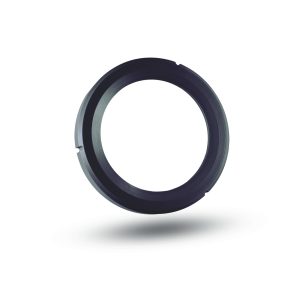
An Arlon 3000XT valve seat
The changing operating envelope
The challenge is acute across severe-service valves, pumps and compressors operating in energy, petrochemical, offshore and hydrogen applications. Equipment is exposed to conditions that push traditional elastomeric materials, including NBR and FKM, beyond their design limits. These materials were not designed for supercritical CO2, hydrogen permeation, deepwater pressure profiles or aggressive chemical streams.
As operators adapt process equipment for new applications, sealing systems must withstand pressure cycling, chemical exposure, decompression events and media permeation in combination, not as isolated conditions. Long-term equipment performance depends on how sealing materials behave across the full operating envelope, including abnormal and transient events.
A seal may perform as expected at installation yet fail prematurely after prolonged exposure to swelling, thermal hardening, chemical degradation or compression set. In severe-service applications, the lower upfront cost of a conventional material can quickly be outweighed by replacement labor, intervention costs, production loss and compliance exposure.
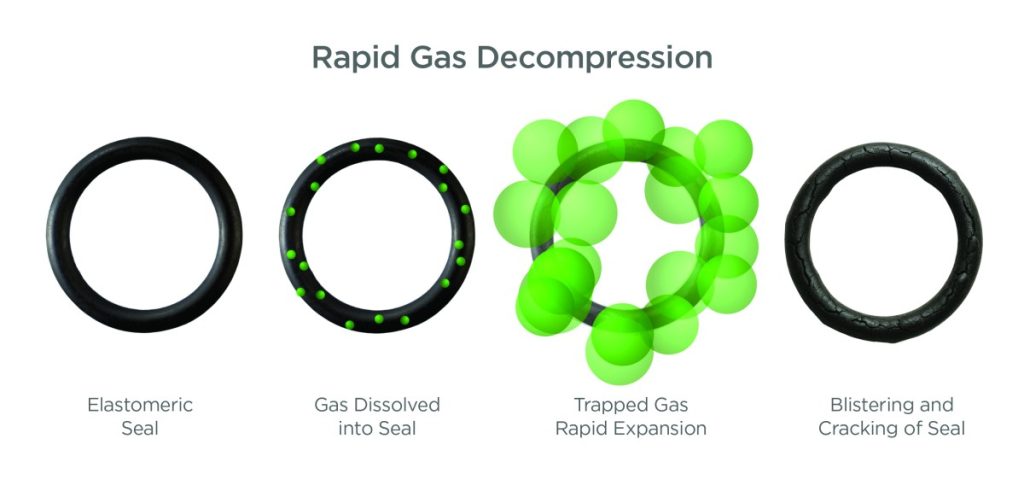 The problem is accelerated in hydrogen infrastructure, carbon capture projects and offshore developments. Hydrogen is especially demanding because its small molecular size combined with extreme operating conditions intensifies permeation, pressure cycling and rapid gas decompression challenges.
During decompression, hydrogen trapped within the elastomer expands rapidly as pressure falls, potentially causing blistering, cracking and seal failure – This becomes a severe issue in hydrogen and supercritical CO2 applications, where gas molecules can permeate deeply into sealing materials under pressure. If the material structure cannot tolerate that expansion, the seal fails from within.
The challenge is not limited to elastomeric seals. In hydrogen pressure-relief systems, thermoplastic valve seats can creep over time, compromising sealing integrity. To address this, a Fortune 500 engineering solutions company replaced legacy seat materials with Greene Tweed’s cross-linked PEEK polymer, Arlon® 3000XT, which has maintained leak-tight performance above 20,000 psi and demonstrated 40 percent lower creep compared with conventional PEEK grades.
Total cost of ownership demands attention to seal design
Traditional material selection practices are no longer sufficient for severe-service environments. For seals in critical energy and process applications, nominal conditions alone rarely reflect real service exposure. Pressure spikes, thermal cycling, chemical variations, decompression events and abnormal process conditions often create transient extremes that determine seal life.
This is particularly problematic in valve systems, where operators often specify seals according to steady-state conditions while underestimating transient events. A seal that tolerates standard operating temperatures may fail repeatedly during startup cycles, shutdown sequences or pressure excursions that exceed its thermal or decompression limits.
These conditions also have consequences beyond the seal itself. Fugitive emissions requirements and broader ESG commitments are forcing operators to reconsider leakage across process systems, which can create exposure to penalties, remediation costs, production disruption and reputational risk. That makes high-integrity sealing a risk-management decision.
Historically, many facilities treated minor leakage as a maintenance issue to be managed reactively. Increasingly, operators view it as a design failure that should be engineered out of the system. Sealing technology represents the front line of emissions control in valves, pumps and compressors. Without high-integrity sealing systems, methane reduction targets or hydrogen containment strategies become difficult to achieve.
Engineering for lifecycle performance
Today, operators are evaluating sealing systems according to lifecycle performance rather than initial purchase cost alone. Seals must be judged by the risk they remove over the life of the asset, from unplanned maintenance and production loss to emissions exposure and system reliability.
High-performance FFKM compounds, advanced PEEK composites and engineered thermoplastics are specified where operators need extended maintenance intervals, lower leakage rates and reliability under severe conditions.
Recent material development reinforces this shift toward application-specific sealing performance. In high-pressure gas systems, seal reliability is often determined not by steady-state conditions but by how materials respond to pressure excursions and decompression events. Greene Tweed’s Fusion® 938 was developed for these demanding environments, providing rapid gas decompression resistance for compressors, valves and pumps while meeting ISO 23936-2 standards. Its development reflects a broader industry trend toward elastomer compounds engineered around specific failure mechanisms and service conditions, helping operators improve reliability and better manage lifecycle risk.
For operators facing pressure to improve uptime, reduce emissions and extend maintenance intervals, reliable sealing technology is critical. The seal may be physically small, but in harsh-service environments it increasingly determines whether the wider system achieves long-term reliability or becomes another source of risk, leakage and downtime.