Labfacility offers a wide range of precision platinum temperature sensing resistors in both wire-wound and flat film construction. All standard items are available in quantity from stock; non-standard detectors can be supplied to order.
- Precision platinum temperature sensors
- Pt100, Pt500, Pt1000 and other values available
- Available from stock
- Wire-wound and flat film types
- Wide range of sizes
- Tolerance values include class A or B, to 1/10th of class B
- Single or duplex detectors
- Specials available to order including alternative Ro values and nickel resistors
Platinum wire-wound detectors comprise a pure platinum wire wound into a miniature spiral and located within axial holes in a high purity alumina rod. The freedom of movement of the platinum wire gives good long-term stability and a wide operating temperature range of -200 to up to +800°C. Labfacility wire-wound detectors are cylindrical in shape and ideally suited for housing within a protective metal tube.
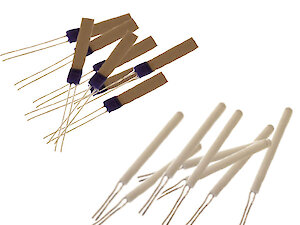 The construction of the wire wound platinum detector uses a large proportion of manual labour, with a high degree of training and skill. The careful selection of all components is vital, as are good working conditions. Complete compatibility between metal, ceramic and glass when used, together with the connecting leads is essential, and most important, strain must be eliminated. Various methods of detector construction are employed to meet the requirements of differing applications.
Although more expensive than flat film alternatives, wire-wound detectors have a wider temperature range (particularly below -50°C) and are readily available in close tolerance classes.
A range of alternative diameters and lengths is available. Duplex detectors containing two platinum resistors are also available.
Platinum flat-film detectors are produced by the deposition of a platinum film on to a flat ceramic substrate, the platinum being sealed to provide protection. Flat-film detectors are available in a range of sizes and are recommended for applications requiring small size, fast response to temperature changes, surface measurement, and resistance to vibration and shock. They are generally less expensive than wire-wound detectors, but the choice of tolerance classes is more limited.
Click here to see our range of wire-wound and Flat Film Detectors on www.labfacility.com