The 12th-16th October is Women in Tech week, an initiative that addresses the gender pay gap in the UK, and offers over 100 in-person and virtual networking events and workshops. In the UK, women make up roughly 25% of the wider tech and STEM workforce, a small proportion compared to the percentage that men make up at approximately 72%1. New data from a recent EngineeringUK blueprint that outlines recommendations to raise the percentage of women on engineering and technology pathways shows the UK is already lagging behind most of Europe when it comes to supporting women in STEM careers2.
With this in mind, Accu has identified where women and girls in STEM are best supported across Europe. Their analysis assesses key indicators, including women’s representation in STEM occupations, the proportion of women among STEM graduates, the share of tertiary-educated women employed in STEM roles, and national gender pay gaps, providing a comparative picture of how effectively different countries enable women to enter, remain, and progress in STEM careers.
Key findings:
- The UK ranks 28th with the highest gender pay gap in Europe (19.8% below men’s earnings)
- Sweden is Europe’s best country for women in STEM, scoring 9.06/10.
- Ireland follows in second place (8.56/10) with a high proportion of women employed in ICT and engineering roles compared to the European average.
- Hungary is Europe’s worst country for women in STEM, scoring 4.56/10.
The best countries in Europe for women in STEM

Please find the full dataset here.
UK ranks 28th in Europe for supporting women in STEM
With a score of 6.25/10, based on factors such as the proportion of female STEM graduates and women employed in such industries, the UK ranks 28th in Europe for supporting women in STEM. The main contributor to the UK ranking is that the country suffers from the worst gender pay gap on the continent at 19.8% below men’s earnings. However, university participation is particularly high, with 40.5% of women among STEM graduates – comparable to frontrunners Iceland and Estonia.
Sweden is Europe’s best country for women in STEM
Sweden ranks first overall with a score of 9.06/10. In Sweden, women account for 24% of Information and Communication Technology (ICT) specialists and 51.3% of the science and technology workforce. Tertiary-educated women employed in STEM also exceed typical European levels with 41%, second only to Luxembourg. Sweden’s gender pay gap is on par with the European average at 11.2% below men’s earnings.
Ireland ranks second for women in STEM
Women account for 24.4% of ICT specialists, 42.4% of the science and technology workforce, and 12.8% of engineers in Ireland, exceeding the median for all three sectors. Tertiary-educated women make up 36.0% of those employed in STEM, while the gender pay gap stands at 8.6%, notably lower than the European average of 11.5%, contributing to Ireland’s high overall score of 8.56/10.
Iceland has the highest number of women graduating in STEM
In Iceland, women comprise 48.4% of the science and technology workforce and 43.3% of tertiary-educated employees in STEM, both of which are well above the respective averages. While women account for a lower 18.6% of ICT specialists, this is offset by a relatively small gender pay gap of 9.8%.
Hungary is Europe’s worst country for women in STEM
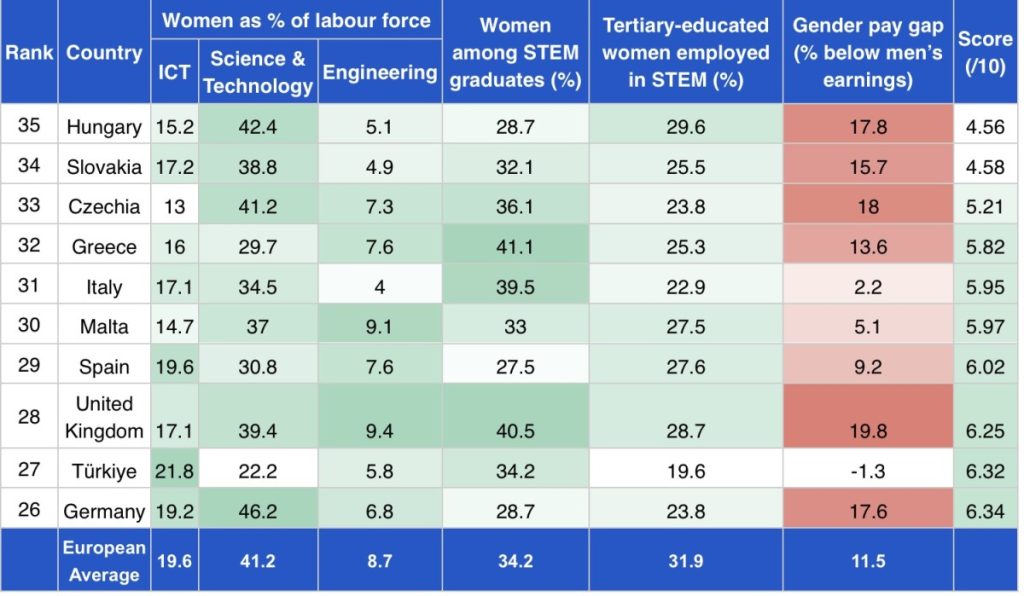
Hungary ranks last overall, reflecting weak outcomes across both participation and labour-market indicators for women in STEM. Women account for 15.2% of ICT specialists and 5.1% of the engineering workforce, both below the European averages of 19.6% and 8.7%, respectively, indicating severe underrepresentation in key technical fields. Although women make up 42.4% of science and technology workers, only 29.6% of tertiary-educated women are employed in STEM roles, and the gender pay gap stands at 17.8%, over six percentage points worse than the European average, contributing to Hungary’s lowest overall score of 4.56/10.
Alastair Morris, UK Managing Director at Accu, comments on the findings:
“When women face barriers entering or progressing in STEM roles, the risk is not just individual career loss but systemic skills shortages and weaker innovation outcomes. Engineering teams benefit greatly from women’s strengths in complex problem-solving and excellent communication skills, and organisations that fail to attract and retain women are effectively narrowing their own technical capability at a time when demand for STEM skills is growing.”
https://www.accu.co.uk/shop/precision-components
Methodology:
- Accu sought to identify the best European countries for women in STEM.
- Country-level data was collected for European countries from Eurostat, covering the following metrics:
a . Workforce participation in STEM
- Share of women among ICT (Information and Communications Technology) specialists
- Share of women employed in science and technology (as a proportion of the labour force)
- Share of women working as scientists and engineers (as a proportion of the labour force) Share of tertiary-educated women employed in science and technology (as a proportion of the labour force)
b. Education pipeline
- Share of women among tertiary STEM graduates
- Female tertiary STEM enrolment per 1,000 people aged 20–29
c. Economic outcomes
- Gender pay gap, expressed as how much less women earn compared with men on average
These indicators together reflect both access to STEM education, representation in STEM employment, and quality of outcomes for women.
- Because all datasets included historical time series, missing values for 2025 were estimated using the Prophet time-series forecasting model. Forecasts were generated separately for each country and metric, using historical trends.
- The 2025 values were used consistently across all indicators to calculate final scores.
- A regional median was calculated. Each country’s performance was then compared with this median to show whether it performs above or below the European norm.
- The data was collected in February 2026 and is accurate as of then.
- Please consult the full dataset here.